44 Flexible Benefits to Offer in 2027, by Life Stage
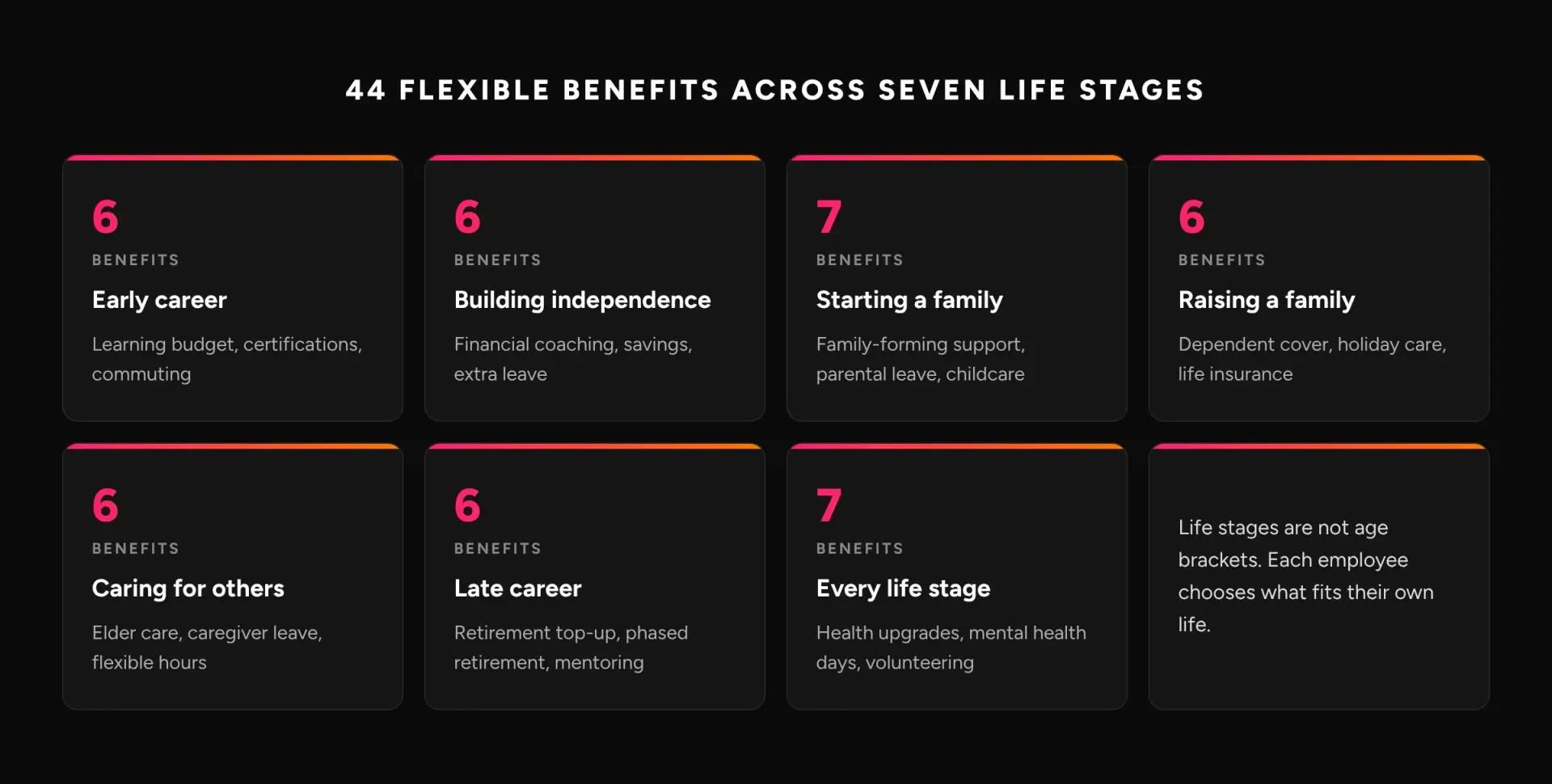
44 flexible benefits examples organised by life stage, with what each one is, why it matters and how to design it.
What employees need from their benefits changes over a career:
- In a first job, someone may care most about learning and getting to work.
- A few years later, the priority might be saving for a home, starting a family or supporting a relative.
- Later still, it might be planning for retirement.
A single fixed package cannot keep up with all of that. Flexible benefits can, because each person chooses what fits their stage instead of receiving the same set as everyone else.
This guide brings together 44 flexible benefits examples, grouped by life stage from early career to pre-retirement, plus benefits that suit every stage. For each one, you will find:
- what it is
- why it matters
- one practical design tip
The final sections explain how to offer these benefits through a flexible plan, and answer common questions.
Why plan by life stage
Needs shift over a working life. Early on, people often focus on skills, pay and getting established. Later, priorities can move towards housing, family, caring responsibilities, health and long-term security. A benefits package designed for one of these stages tends to feel irrelevant to employees at the others.
Looking at benefits through life stages helps in three ways:
- It shows gaps. If most of your benefits support parents of young children, people at other stages may feel overlooked.
- It helps you build a balanced menu, with something meaningful for everyone.
- It supports a fair budget. You can give every employee the same flexible allowance and let them spend it on what matters to them, rather than funding benefits only some people can use.
To see how this connects with what employees say they value, read our guide to the benefits employees value most.
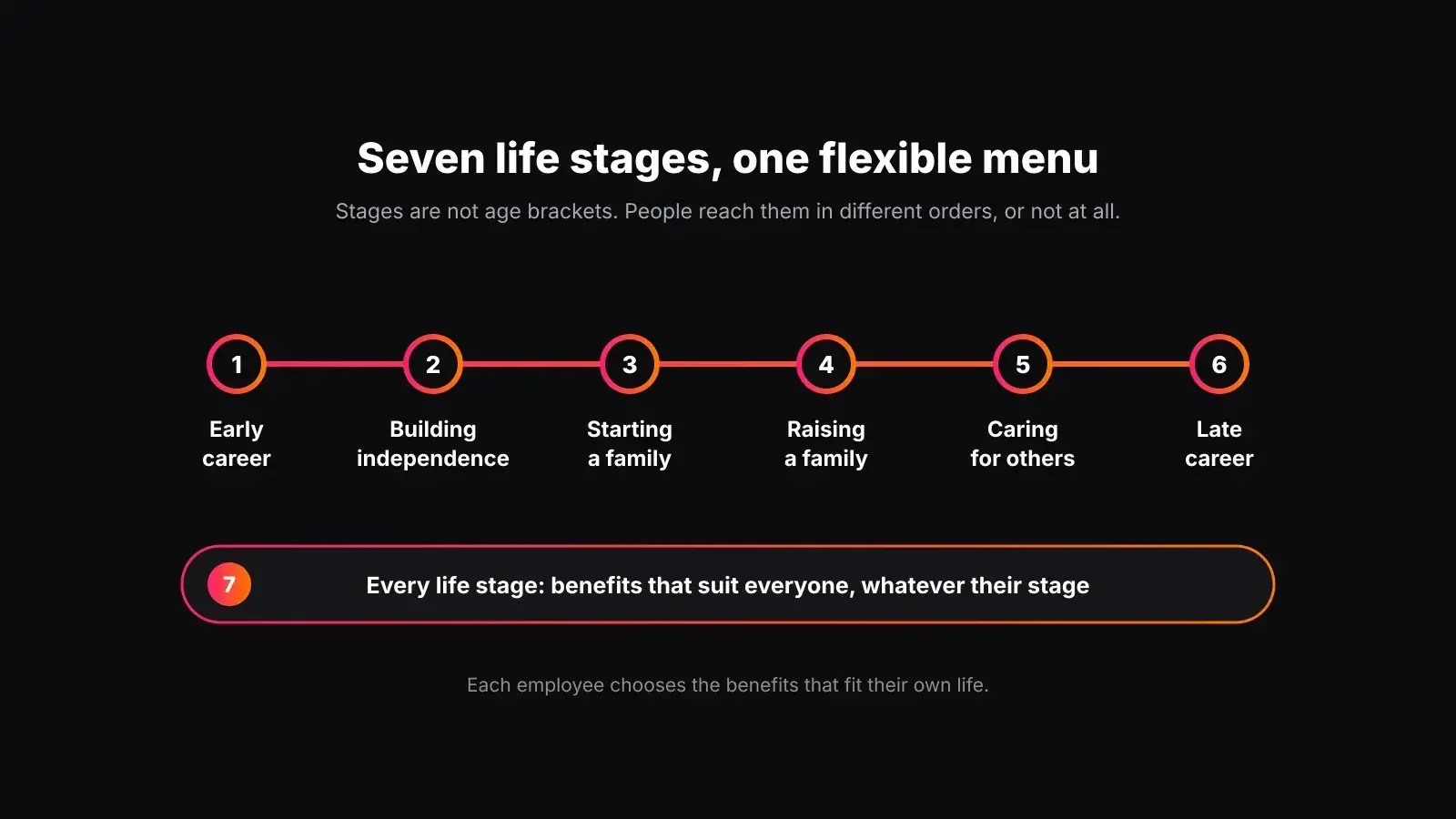
One important point: life stages are not age brackets. People reach these stages in different orders and at different ages, and many never reach some of them at all. For example, someone may:
- start a family in their twenties or their forties
- care for a parent while raising children
- change careers late, and be "early career" again
Families also take many forms, including single employees, single parents, same-sex couples, adoptive and foster parents, and people caring for relatives.
Every benefit in this list is written for all eligible employees, whatever their age, gender or family type. That is the point of flexible choice: each employee picks what fits their life.
Life stage | What employees often prioritise | Example benefits from this list |
|---|---|---|
Early career | Skills, career growth and everyday costs | Learning budget, certification support, commuting allowance |
Building independence | Financial stability, a home and personal time | Financial coaching, emergency fund support, extra annual leave |
Starting a family | Support to form a family and time to adjust | Family-forming support, parental leave top-up, childcare help |
Raising a family | Family health, education and protection | Dependent cover upgrades, school holiday care, life insurance |
Caring for others | Time, flexibility and practical help with care | Elder care navigation, caregiver leave, flexible scheduling |
Late career and pre-retirement | Health, security and passing on knowledge | Retirement top-up, phased retirement, mentoring roles |
Every life stage | Health, wellbeing, purpose and recognition | Health upgrades, mental health days, volunteering days |
Caption: What employees often prioritise at each life stage, with example benefits from this guide.
Early career
Employees early in their career often focus on building skills, growing in their role and managing everyday costs. Benefits that support learning, getting to work and staying well tend to matter most at this stage, though people of any age can be early in a new career.
1. Learning and development budget
A learning budget gives employees an annual amount to spend on courses, books, conferences or online learning of their choice. Early in a career, it helps people build skills quickly, and shows that the employer invests in their growth.
Design tip: Set clear categories and a simple approval process. If your plan allows, let unused budget roll over for larger courses. Our guide to learning stipends covers this benefit in more depth.
2. Professional certification support
This benefit covers the cost of professional exams, certifications and related study materials, and sometimes paid study time. For employees building a career, a recognised qualification can open doors and increase confidence.
Design tip: Agree up front:
- which certifications qualify
- whether study leave is included
- whether any repayment applies if someone leaves soon after the employer pays
Keep any repayment terms simple and clearly written.
3. Commuting and mobility allowance
A commuting allowance helps with the cost of getting to work, through public transport passes, parking or shared mobility services. Where available, it can also include bike or electric vehicle schemes, which suit employees at every stage who want a more sustainable commute.
Design tip: Offer several mobility options within one allowance. Then employees in cities, and in places with limited public transport, can both benefit.
4. Phone and internet allowance
This allowance contributes to the cost of a mobile phone plan or home internet, which many employees now rely on for work. It is simple to explain, and useful for people setting up on their own for the first time.
Design tip: Decide whether the allowance is fixed or reimbursed against bills. Check how it should be treated for tax and payroll in each country.
5. Student loan repayment support
Where offered locally, this benefit helps employees pay down student loans, either through direct contributions or matched savings. It can make a real difference to people early in their career who are carrying education debt.
Design tip: Availability and tax treatment vary widely by country, so check local rules and take advice. In countries where it does not fit, offer an equivalent through financial coaching or savings support.
6. Mental health and counselling support
This benefit gives employees access to confidential counselling, therapy sessions or mental health apps. Starting a career can bring pressure, uncertainty and change, and early support helps people build healthy habits.
Design tip: Make access easy and confidential, with options for online and in-person support, in more than one language. Mental health days, covered later in this guide, work well alongside it.
Building independence
At this stage, employees are often setting up their own home, managing money independently and building savings. Benefits that support financial stability, a good working setup and time for life outside work tend to resonate.
7. Financial coaching and budgeting tools
Financial coaching gives employees one-to-one sessions with a qualified coach, along with tools to plan budgets, manage debt and set savings goals. It helps people take control of their finances as they become more independent.
Design tip: Keep coaching impartial and focused on education rather than selling products. Our guide to financial wellness benefits explores how to get employees using these services.
8. Savings or emergency fund support
This benefit helps employees build a savings buffer, often through payroll savings, or an employer contribution that matches what employees put aside. A small emergency fund can stop an unexpected bill becoming a crisis.
Design tip: Make saving automatic through payroll where possible, and let employees access their savings quickly when they need them. Check local rules on how employer contributions are treated.
9. Home office and hybrid setup allowance
A home office allowance helps employees buy a desk, chair, monitor or other equipment for working from home. For people setting up their own space, it supports comfort and productivity. It also suits employees at every stage who work in a hybrid pattern.
Design tip: Offer a one-off setup amount, plus a smaller allowance for later replacements. Agree what happens to the equipment if someone leaves.
10. Rental deposit or relocation support
This benefit helps employees with the upfront costs of moving, such as a rental deposit, moving costs or temporary accommodation. It can make it easier for people to take a new role or move closer to work.
Design tip: Consider offering deposit support as an interest-free advance, repaid through payroll, with clear limits and repayment terms. Check local rules before offering loans to employees.
11. Buying extra annual leave
This option lets employees exchange part of their pay or flexible budget for extra days of leave. It suits people who value time for travel, family or personal projects more than extra benefits.
Design tip:
- Set a maximum number of days that can be bought each year.
- Agree how bought leave is scheduled.
- Make sure local leave rules are followed.
Some plans also let employees sell unused days, where local rules allow.
12. Pet insurance or pet care allowance
Pet insurance helps cover vet bills. A pet care allowance can help with costs such as pet sitting or daycare. For many employees, pets are part of the family, and unexpected vet bills can be stressful.
Design tip: Offer pet care as a flexible menu option rather than a core benefit. Employees with pets can choose it, and others can spend their budget elsewhere.
Starting a family
Employees forming a family, in whatever way, often look for support with the process itself, time to adjust and help with childcare. Families form through birth, adoption, surrogacy and fostering, and these benefits should be open to everyone on the same terms.
13. Fertility and family-forming support
This benefit helps with the costs and emotional demands of forming a family, including fertility treatment, adoption, surrogacy and fostering. It supports single people and couples of any gender or orientation.
Design tip:
- Write eligibility in inclusive terms.
- Cover several paths to parenthood.
- Include emotional support alongside financial help.
Check local rules, as the treatments and arrangements available differ between countries.
14. Enhanced parental leave top-up
This benefit adds to the parental leave employees receive under local rules, either by extending the paid period or topping up pay. It gives new parents more time to bond with a child and adjust to family life.
Design tip: Offer the same enhancement to all parents, including adoptive parents and those who become parents through surrogacy. Make the policy easy to find.
15. New-parent support and coaching
New-parent coaching helps employees prepare for leave, stay connected while they are away and plan their return. It can include one-to-one coaching, parent networks and practical guides for managers.
Design tip: Offer coaching before, during and after leave, and include managers so they know how to support a smooth transition. It can also help employees returning after other long absences.
16. Childcare allowance or vouchers
A childcare allowance or vouchers help employees pay for nurseries, childminders or after-school care. Childcare can be one of the largest costs for working parents, and support here can make it easier to return to work.
Design tip: Availability and tax treatment of childcare vouchers and allowances vary by country. Check local rules and take advice before choosing a format.
17. Back-up childcare
Back-up childcare gives employees emergency care when their usual arrangements fall through, such as when a nursery closes or a carer is ill. It helps parents avoid missing work at short notice. It remains useful for parents of older children too.
Design tip: Offer a set number of days a year and make booking simple, with options for in-home and centre-based care where available.
18. Flexible return-to-work arrangements
This benefit gives parents returning from leave the option of a phased return, reduced hours or flexible scheduling for an agreed period. It eases the transition back, and helps employers keep experienced people.
Design tip:
- Set out the options in a clear policy.
- Agree a review point with each employee.
- Make the same options available to employees returning from other long absences, such as caregiver leave.
19. Adding dependents to health cover
This benefit lets employees add a partner, children or other dependents to their health insurance, sometimes with the employer covering part of the cost. Adding a new family member to cover is often one of the first things new parents need.
Design tip: Define "dependent" inclusively, covering partners of any gender and adopted and foster children. Allow changes after life events.
Raising a family
As children grow, many employees shift their focus to family health, education and protecting their family's future. Benefits that help with school-age care and long-term security tend to matter at this stage.
20. Education or tuition support for children
This benefit contributes to the cost of children's education, such as school fees, tutoring or educational resources. For families, it can ease one of the largest long-term costs.
Design tip:
- Set clear eligibility and limits.
- Decide which types of education qualify.
- Check how the benefit should be treated for tax in each country.
Some employers offer it as a flexible menu option rather than to everyone.
21. School holiday care
School holiday care helps parents with childcare during school breaks, through holiday camps, activity clubs or care allowances. Holidays can be hard to cover when parents work, especially for single parents or families without relatives nearby.
Design tip: Share options well before each holiday period. Consider partnering with local providers so employees can book easily.
22. Family activities allowance
A family activities allowance helps employees pay for activities they share with their family, such as sports clubs, music lessons or days out. It supports wellbeing and time together.
Design tip: Define "family" broadly so the allowance works for every household. That includes employees without children who want to spend it on time with relatives or friends.
23. Life insurance top-up
A life insurance top-up lets employees increase their cover above the core level the employer provides. People with dependents often want more protection to secure their family's future. Employees at any stage with financial responsibilities may value it.
Design tip: Offer a few clear levels of extra cover. Explain any health questions or evidence an insurer may need for higher levels.
24. Will writing and estate planning support
This benefit gives employees access to a will-writing service or advice on estate planning. Many people put off making a will, even after they have children or own property. It is equally useful later in a career.
Design tip: Offer it as a low-cost menu option or a one-off service. Remind employees about it after life events such as a birth, an adoption or a marriage.
25. Dental and vision upgrades for dependents
This benefit lets employees upgrade dental and vision cover for family members already on their plan, for example to include orthodontics or more eye care. Children's dental and eye care can be regular and costly.
Design tip: Price upgrades clearly so employees can compare them with other options in their flexible budget. Allow changes at each enrolment window.
Caring for others
Many employees support a parent, partner, relative or friend who needs care. Some are in the "sandwich" years, caring for children and older relatives at once. At this stage, time, flexibility and practical help often matter more than anything else.
26. Elder care support and navigation services
Elder care navigation gives employees expert help to find and arrange care for an older relative, including care homes, home care and local support services. Caring decisions are often urgent and hard to research alone.
Design tip: Offer a service that can help in several countries, in case employees' relatives live abroad. Our guide to elder care and caregiving benefits explores this area in more detail.
27. Paid caregiver leave
Paid caregiver leave gives employees a set number of paid days each year to care for a relative or someone close to them. It helps people handle appointments, emergencies and changes in care without using annual leave.
Design tip:
- Define "someone close to them" broadly, not just immediate family.
- Keep the request process simple and confidential.
- Check how it fits with any local leave rights.
28. Back-up adult and elder care
Back-up adult care provides short-notice care for an adult relative when usual arrangements fall through. It helps caregivers keep working when a carer is unavailable or a relative needs extra help.
Design tip: Offer a set number of days a year and include in-home care options. It works well alongside back-up childcare for employees caring for children and parents at the same time.
29. Employee assistance programme
An employee assistance programme offers confidential support on personal, family, work and financial issues. It usually works through a phone line, online resources and short-term counselling. For caregivers, it can be a first point of contact when things become difficult.
Design tip:
- Promote it regularly.
- Explain what it covers in plain language.
- Make sure it is available in every country where you employ people.
30. Flexible or compressed scheduling
Flexible scheduling lets employees adjust their start and finish times. Compressed scheduling lets them work their hours over fewer days. Both help caregivers fit work around appointments and care routines.
Design tip: Set out clear options and a fair process for requests. Make them available to all employees where the role allows, not only to carers or parents.
31. Legal and financial advice for care decisions
This benefit gives employees access to advice on legal and financial questions linked to care, such as powers of attorney, care costs and managing a relative's affairs. These decisions can be complex and stressful.
Design tip: Offer advice through a trusted service that covers the countries where employees and their relatives live. Remind employees that the rules vary by country.

Late career and pre-retirement
Employees later in their career often focus on health, financial security and the move towards retirement. Many also want to share what they have learned. Benefits that support planning, flexibility and wellbeing tend to matter most.
32. Retirement savings top-up
A retirement savings top-up lets employees increase their retirement contributions, sometimes with an employer match. Later in a career, many people want to boost their savings before they retire.
Design tip: Availability, limits and tax treatment of retirement contributions vary by country, so check local rules and take advice. Make it easy for employees to see how a top-up changes their projected savings.
33. Retirement planning advice
This benefit gives employees guidance on retirement income, savings options and timing. Good advice helps people make confident decisions about when and how to retire. Employees at earlier stages may also find a basic session useful.
Design tip: Offer advice in group sessions and one-to-one, keep it impartial, and make it available well before retirement.
34. Phased retirement or reduced hours
Phased retirement lets employees gradually reduce their hours or responsibilities before they fully retire. It helps people adjust, and lets employers plan how knowledge is handed over.
Design tip:
- Set out clear options.
- Explain how reduced hours may affect pay, benefits and retirement savings.
- Check local rules on pensions and employment before agreeing arrangements.
35. Health screenings and preventive checks
This benefit offers regular health screenings and preventive checks, such as heart, cancer or general health assessments. Many people value prevention and early detection more later in life.
Design tip: Offer screenings at convenient times and places, and keep results confidential. Make them available to employees at every stage, with checks tailored by need rather than by age alone.
36. Critical illness cover
Critical illness cover pays a lump sum if an employee is diagnosed with a serious illness listed in the policy. It can ease financial pressure during treatment and recovery.
Design tip: Offer it as a flexible menu option, with clear explanations of what is covered. Where it is available locally, some employers also offer long-term care insurance as a related option.
37. Mentoring and knowledge-sharing roles
This benefit gives experienced employees a formal role in mentoring others or leading knowledge-sharing sessions. It recognises their expertise and helps them stay engaged, while passing on skills that are hard to replace. It also benefits early-career employees looking for guidance.
Design tip: Include mentoring time in workloads, offer training for mentors, and recognise their contribution.

Benefits for every life stage
Some benefits are valuable to almost everyone, whatever their stage. These often work well as core benefits or as standard options on every menu. They help employees feel supported throughout their career.
38. Health insurance upgrades
Health insurance upgrades let employees increase their medical cover above the core level, for example with faster access to specialists or a wider choice of hospitals. Health needs vary at every stage, and an upgrade lets each person decide how much cover they want.
Design tip: Offer a few clear levels and price them transparently. Allow changes at each enrolment window and after life events.
39. Fitness and wellbeing allowance
A fitness and wellbeing allowance helps employees pay for gym memberships, fitness classes, sports equipment or wellbeing apps. It supports physical and mental health in a way each person can tailor.
Design tip: Keep eligible categories broad enough to include different activities and abilities. Consider offering it through a flexible spending account or wallet so employees can choose.
40. Mental health days
Mental health days give employees a set number of paid days each year to rest and recover, without needing to explain why. They support wellbeing and can help prevent burnout.
Design tip:
- Make them easy to take.
- Encourage managers to take them too.
- Keep them separate from sick leave, so employees do not feel they must be ill to rest.
41. Volunteering days
Volunteering days give employees paid time to support a cause they care about. They help people connect with their community and find purpose outside their role.
Design tip: Let employees choose their own causes within simple guidelines. Share stories of how colleagues use their days, to encourage take-up.
42. Employee discounts
Employee discounts give access to lower prices on everyday goods and services, such as groceries, travel or entertainment. They can help with living costs at any stage.
Design tip: Choose a discount offer that works in every country where you employ people, and make it easy to find on a phone. Discounts work well as a low-cost addition to a flexible plan.
43. Sabbaticals
A sabbatical gives employees an extended break, paid or unpaid, after a period of service. People use sabbaticals to travel, study, care for family or simply recharge. Sabbaticals can be valued at any stage of a career.
Design tip:
- Set clear eligibility, length and pay terms.
- Plan cover in advance.
- Agree how the employee will return.
44. Recognition and experiences
This benefit rewards employees with experiences, such as travel, events or personal activities, either as part of recognition or through a dedicated allowance. Experiences can feel more memorable than cash or gifts.
Design tip: Let employees choose from a range of experiences that suit different interests and budgets. Connect experiences to recognition moments such as milestones or achievements.
How to offer them in a flexible plan
A life-stage menu works best inside a clear flexible benefits structure. These choices turn a list of good ideas into a plan employees can use.
- Decide what is core and what is flexible.
Benefits that protect everyone usually sit in the core. Benefits that matter more to some people than others work well in the flexible menu. - Core benefits are the ones every eligible employee receives, such as base health cover, life insurance or an employee assistance programme.
- Flexible benefits are the options employees choose from.
- Use a budget or allowance. Give each employee a flexible budget or allowance to spend across the menu. This keeps costs predictable and treats employees fairly, because everyone receives the same value and spends it on what matters to them.
- Let choices change at life events. Allow employees to update their choices at each enrolment window, and when something important changes, such as:
- the arrival of a child
- a new caring responsibility
- a move to a new country
- Keep the menu manageable. Forty-four benefits is a long list. Most plans offer a focused selection, grouped clearly, so employees can find what suits them without feeling overwhelmed. Start with the benefits that fit your workforce best and add more over time.
- Plan for local differences. Availability, tax treatment and practice vary by country. Agree a global principle, such as one flexible budget and a shared core. Then adapt the menu locally, with advice from tax, payroll and legal advisers.
- Review take-up each year. Look at what employees chose, what they ignored and what they asked for. Then adjust the menu, the budget and the communication.
- Choose how you will run it. A life-stage menu across several countries is easier to manage with a system that handles budgets, choices and life events in one place. Our guide to flexible benefits platforms explains the options. As one example, Tallect's Benefits & Insurance module offers:
- Standard and Flex benefit options
- choices employees manage themselves
- centralised budget and spend management
- a globally consistent benefits framework that stays regionally compliant
Benefit type | Often core for everyone | Often in the flexible menu | Why |
|---|---|---|---|
Health cover | Base level of medical cover | Upgrades and adding dependents | Protects everyone, while needs above the base differ |
Life and protection | Base life insurance | Top-ups and critical illness cover | Needs grow with dependents and responsibilities |
Mental health | Employee assistance programme | Counselling sessions and mental health days | Everyone needs a safety net; extra support varies |
Family and caregiving | Leave under local rules | Childcare, elder care and back-up care | Only some employees need each type of support |
Financial wellbeing | Retirement contribution under local rules | Top-ups, coaching and savings support | Priorities change across a career |
Learning | Role-required training | Learning budget and certifications | Personal development goals differ |
Lifestyle and time | Standard annual leave | Extra leave, fitness, pets and experiences | Personal choices with no single right answer |
Caption: Which benefits usually sit in the core for everyone, and which work better as flexible options.
Frequently asked questions
What are some examples of flexible benefits?
Examples include:
- learning budgets
- commuting allowances
- financial coaching
- extra annual leave
- fertility and family-forming support
- childcare help
- elder care services
- caregiver leave
- retirement savings top-ups
- health insurance upgrades
- fitness allowances
- volunteering days
Most plans combine a core set of benefits for everyone with a menu of options employees choose from, so each person can pick what fits their life stage.
What are the most popular flexible benefits?
It depends on your workforce, so the best approach is to find out directly:
- survey employees about what they value and what is missing
- look at take-up data from your current benefits
- run focus groups with people at different life stages
Compare the results by country, role and working pattern. This shows which benefits your employees actually choose, rather than relying on general lists.
What is a life-stage benefits approach?
A life-stage approach designs benefits around the different points people reach in their lives, such as starting a career, forming a family, caring for others or preparing for retirement.
Life stages are not age brackets. People reach them in different orders, or not at all. The approach helps employers build a balanced menu, so every employee can find benefits that fit their current situation.
How do you decide which flexible benefits to offer?
- Start with your goals and your budget.
- Look at your workforce: their locations, family situations, working patterns and stated priorities.
- Map your current benefits against the life stages to find gaps.
- Shortlist benefits that fill those gaps and fit local practice in each country.
- Test the shortlist with employees before launch.
- Review take-up each year to refine the menu.
How many options should a flexible benefits menu include?
There is no single right number. The menu should be broad enough to give every employee meaningful choice, but focused enough that people can understand it quickly.
Many employers start with a smaller set of well-explained options and add more over time. Group options clearly, by category or life stage, and remove options few people choose so the menu stays easy to use.
Are flexible benefits fair to employees without children?
They can be fairer than a fixed package. When every employee receives the same flexible budget, people without children can spend it on what matters to them, such as:
- learning
- extra leave
- fitness
- pets
- caring for relatives
- experiences
A good menu includes valuable options for every life stage and family type, so no group ends up subsidising benefits it cannot use.
Can employees change their flexible benefits after a life event?
Usually, yes. Most flexible plans let employees change their choices during an annual enrolment window, and after a qualifying life event, such as:
- the arrival of a child
- a marriage or partnership
- a new caring responsibility
- a move to a new country
The events that allow changes depend on the plan rules and local requirements, so check your plan documents and ask HR.
Do flexible benefits work the same way in every country?
No. The idea of offering choice is the same everywhere, but the benefits available, how they are taxed and how they are delivered vary by country. Some benefits exist only in certain markets, such as childcare vouchers, student loan support or salary sacrifice schemes.
Employers usually keep one global approach and adapt the menu locally, with advice from tax, payroll and legal advisers.
Build a benefits menu for every life stage
Tallect lets employees choose from Standard and Flex benefits that fit their life stage, with centrally managed budgets across your countries.