ESOPs for Listed Companies: The SEBI SBEB Regulations Explained
Who can get ESOPs, when a trust is needed, the one-year vesting rule and what to disclose: the SEBI SBEB Regulations, 2021 in plain English
Most ESOP problems at listed companies aren't legal puzzles. They're record-keeping slips with legal consequences, such as:
- a trust that quietly buys more than 2% of capital in a year
- a pre-IPO scheme used for new grants before shareholders ratified it
- a disclosure in the annual report that doesn't match the grant register the auditors are testing
The rules sit in one place: the SEBI (Share Based Employee Benefits and Sweat Equity) Regulations, 2021, usually called the SBEB Regulations.
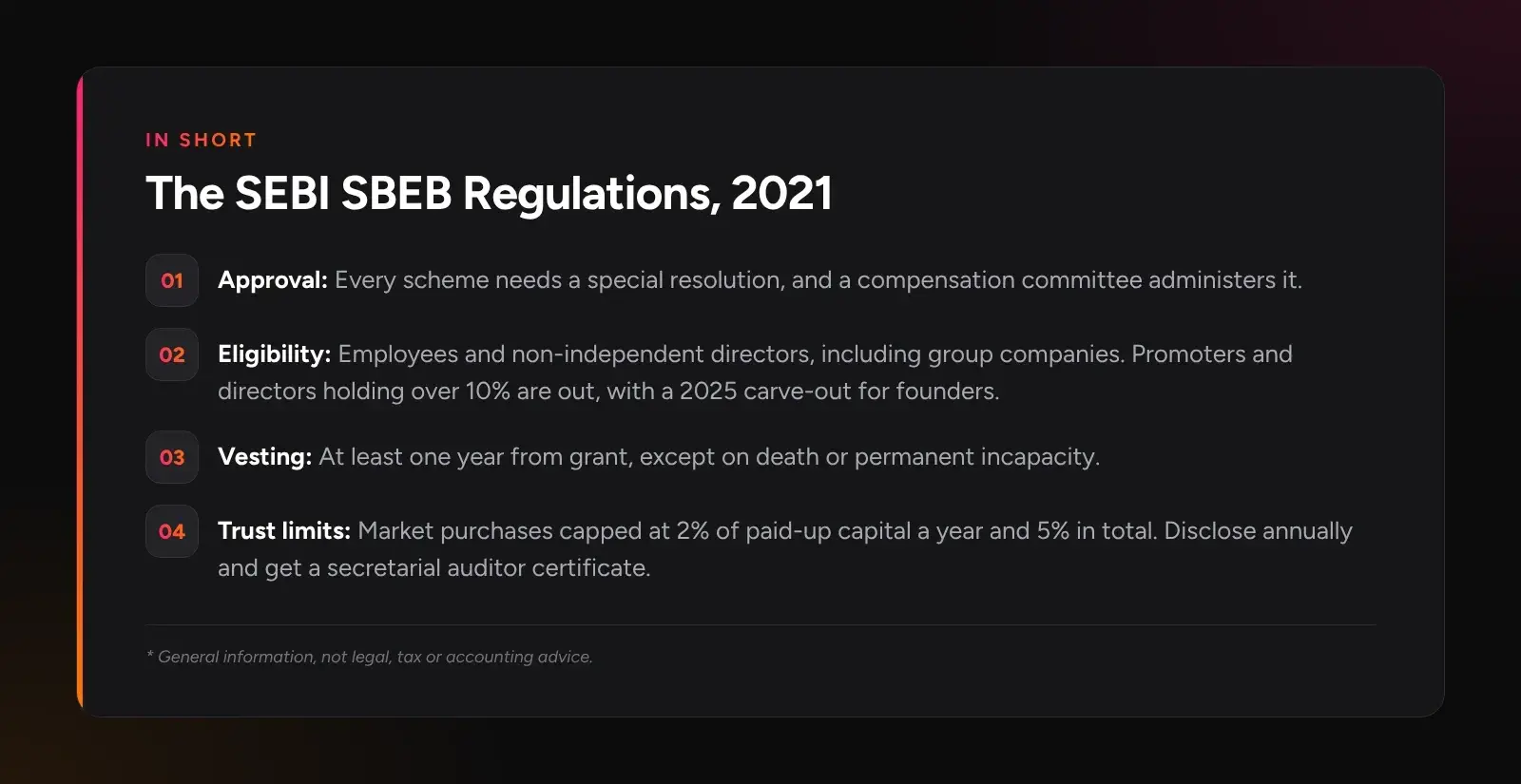
The short version:
- Shareholders approve every scheme by special resolution, and a compensation committee runs it.
- Options can't vest earlier than one year after grant.
- Promoters, and directors holding more than 10%, aren't eligible.
- A trust that buys shares on the market can buy up to 2% of paid-up capital a year and hold up to 5% in total.
- Every year, the company discloses the details, and its secretarial auditor certifies compliance at the AGM.
What are the SBEB Regulations?
SEBI notified the SBEB Regulations on 13 August 2021. They replaced two earlier sets of rules:
- the SEBI (Share Based Employee Benefits) Regulations, 2014
- the SEBI (Issue of Sweat Equity) Regulations, 2002
A single rulebook now covers every share-based benefit a listed company offers.
The regulations apply to companies whose shares are listed on a recognised stock exchange in India. Unlisted companies follow Section 62(1)(b) of the Companies Act, 2013 and Rule 12 of the Companies (Share Capital and Debentures) Rules, 2014 instead.
Two amendments followed in 2025:
- 8 September 2025: A new Regulation 9A lets founders who are named as promoters in an IPO filing keep ESOPs granted at least a year earlier.
- 4 December 2025: Sweat equity valuations move from merchant bankers to independent registered valuers, from 2 January 2026.
Listed vs unlisted companies
Rule | Unlisted company (Companies Act and Rule 12) | Listed company (SBEB Regulations) |
|---|---|---|
Shareholder approval | Special resolution | Special resolution, plus separate ones in some cases |
Who runs the scheme | Board, or a committee the board appoints | Compensation committee, or the nomination and remuneration committee |
Minimum vesting | One year | One year |
Promoters and 10% directors | Not eligible, except in startups up to 10 years old | Not eligible, except under Regulation 9A |
Trust buying from the market | Not applicable; trust funding capped at 5% under Rule 16 | Up to 2% a year and 5% in total |
Disclosure | Board's report | Board's report under Part F, plus a secretarial auditor certificate |
Listing of shares | Not applicable | In-principle approval from the stock exchanges |
Caption: How ESOP rules differ for unlisted and listed companies in India.
The move from the left column to the right catches companies out more than any single rule. A scheme drafted for a private company usually gives the board wide discretion. After listing, many of those discretions need a committee decision, a special resolution or a disclosure. Read the scheme again, line by line, the year before the IPO.
Which schemes are covered?
Scheme | What the employee gets | Specific rule to know |
|---|---|---|
Employee stock option scheme (ESOS) | The right to buy shares at a set price after vesting | Minimum one-year vesting; the company can add a lock-in |
Employee stock purchase scheme (ESPS) | Shares offered for purchase straight away | One-year lock-in from allotment |
Stock appreciation rights (SAR) | The rise in share value, in cash or shares | Can be cash-settled or equity-settled (Regulation 23(2)) |
General employee benefits scheme (GEBS) | Benefits such as healthcare or scholarships, funded partly by company shares | Company shares can be no more than 10% of the scheme's assets |
Retirement benefit scheme (RBS) | Retirement benefits funded partly by company shares | Same 10% limit |
Sweat equity | Shares for know-how or value added | Up to 15% of paid-up capital a year and 25% in total |
Caption: The schemes covered by the SBEB Regulations, and the key rule for each.
Options under an ESOS make up most listed company grants. Equity-settled SARs deserve more attention than they get. They deliver the same gain as an option, issue fewer shares and spare employees the cash to exercise.
Two instruments sit outside the categories:
- Restricted stock units aren't a separate category. Listed Indian companies usually grant them as options with a nominal exercise price under an ESOS.
- Purely cash phantom plans that never involve dealing in shares have historically been treated as outside the regulations. That follows SEBI's informal guidance to Saregama India in 2015, so check yours with counsel.
For how these instruments compare, see phantom stock vs SARs vs ESOPs.
Who can receive ESOPs?
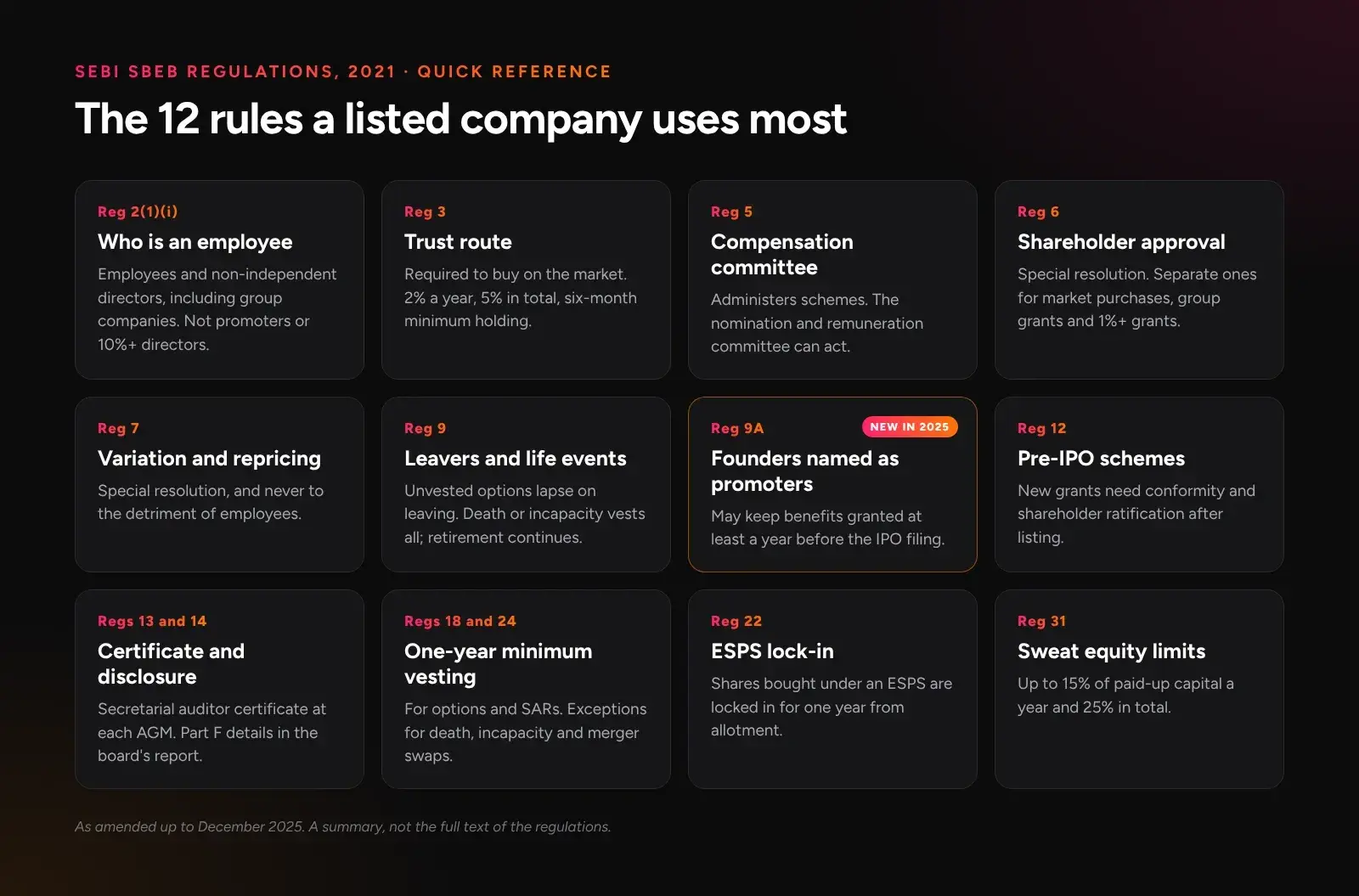
Regulation 2(1)(i) defines an employee as:
- an employee designated by the company who works exclusively for it, in India or abroad
- a director, whole-time or not, other than an independent director
- an employee or director of a group company, subsidiary, associate or holding company, in India or abroad
Two groups are excluded:
- promoters and members of the promoter group
- directors who hold more than 10% of the company's equity, directly or through relatives or companies they control
Group grants are where this trips companies up. Take an engineer in Austin employed by the listed company's US subsidiary. She's eligible, but only if shareholders passed the separate resolution for subsidiary employees that Regulation 6(3) requires. Without it, her grant has a problem, however well the letter is drafted.
What changed for founders in 2025?
Before September 2025, founders named as promoters in an IPO filing were generally expected to give up their ESOPs before filing.
The new Regulation 9A changes that. A person identified as a promoter in the draft offer document can now keep and exercise options, SARs or other benefits granted at least one year before the filing.
The background explains the change. In May 2025, Paytm's founder settled SEBI proceedings over ESOPs granted around the 2021 IPO, and surrendered 21 million options worth over INR 1,800 crore (Bar and Bench). Regulation 9A replaces case-by-case uncertainty with a clear rule.
It covers existing grants only. Once someone is a promoter of a listed company, new grants are off limits.
Do you need an ESOP trust?
Only if the scheme will buy shares on the market, or you have a clear reason to hold shares centrally.
A company can run a scheme in one of two ways (Regulation 3):
- directly, by issuing new shares
- through an irrevocable trust
The trust route is required for secondary acquisition, which means buying existing shares on a stock exchange.
A trust is often set up out of habit. It brings trustees, a trust deed, inventory deadlines and a yearly reconciliation. For a company that's comfortable issuing new shares, that's cost without much benefit.
If you do use a trust, these rules apply:
- Separate approval: Shareholders must approve secondary acquisition by a separate special resolution.
- Annual limit: Up to 2% of paid-up equity capital in a financial year.
- Overall limits:
- 5% for ESOS, ESPS and SAR schemes
- 2% for GEBS and RBS
- 5% for all schemes together
- Minimum holding: Six months for shares bought on the market, subject to permitted transfers, such as transfers to employees under the scheme.
- Unappropriated inventory: Shares not yet allotted to employees must be used by the end of the following financial year, or the year after with the committee's approval.
- Trustees: These people can't be trustees:
Trustees can't vote the trust's shares, and the trust can't deal in derivatives. - directors
- key managerial personnel
- promoters
- their relatives
- anyone holding 10% or more
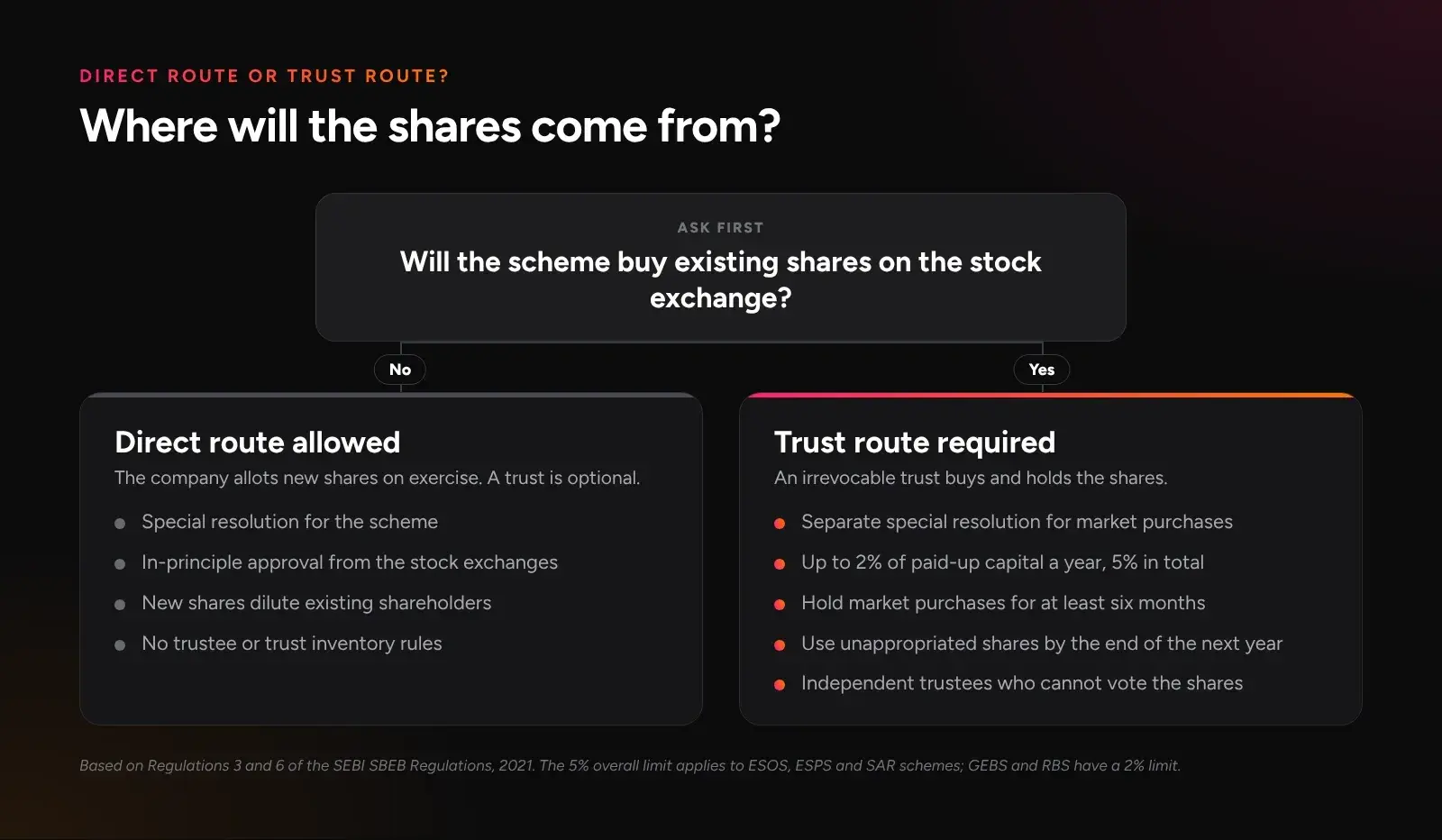
The trust route doesn't change what an ESOP is worth. It changes where the shares come from.
What approvals are needed?
- Compensation committee: Set one up under Regulation 5, or designate the nomination and remuneration committee. It frames the detailed terms under Part B of Schedule I, and the policies that prevent insider trading.
- Special resolution: Shareholders approve each scheme (Regulation 6(1)).
- Separate special resolutions (Regulation 6(3)) are needed for:
- secondary acquisition
- grants to employees of a subsidiary or holding company
- grants to any one employee, in a year, of 1% or more of issued capital
- Stock exchange approval: In-principle approval before grants, and listing of shares on exercise (Regulations 10 and 12).
The 1% resolution is the one that slips. It usually surfaces only after a new CEO's joining grant has been negotiated, signed off by the committee and announced, before anyone checks it against issued capital.
Varying a scheme needs a special resolution, and the change must not hurt employees' interests (Regulation 7(1)). Changes required by law are an exception.
Repricing options that have become unattractive because the share price fell is allowed, again by special resolution (Regulation 7(5)).
Pricing, vesting and lock-in
- Pricing: The company sets the exercise price freely, subject to the accounting rules (Regulation 17).
- Vesting: At least one year between grant and vesting, for options and SARs (Regulations 18 and 24). There are three exceptions:
- death
- permanent incapacity
- options substituted after a merger, where time already served counts
- Lock-in: Optional for shares from an ESOS (Regulation 18(2)). Mandatory for one year for ESPS shares (Regulation 22(2)).
- Transfer: Options and SARs can't be transferred, pledged or mortgaged. A broker, the company or the trust can fund the exercise price and tax, which allows cashless exercise (Regulation 9).
When an employee leaves, retires or dies
Event | Unvested options | Vested options |
|---|---|---|
Resignation or termination | Lapse on the day | Can be exercised within the period the committee sets |
Retirement or superannuation | Continue to vest on schedule | Exercisable as per the scheme |
Death | Vest immediately, in the legal heirs or nominees | Exercisable by the legal heirs or nominees |
Permanent incapacity | Vest immediately | Exercisable as per the scheme |
Transfer within the group | Continue, if the treatment is not prejudicial | Continue |
Caption: What happens to unvested and vested options in each leaver event.
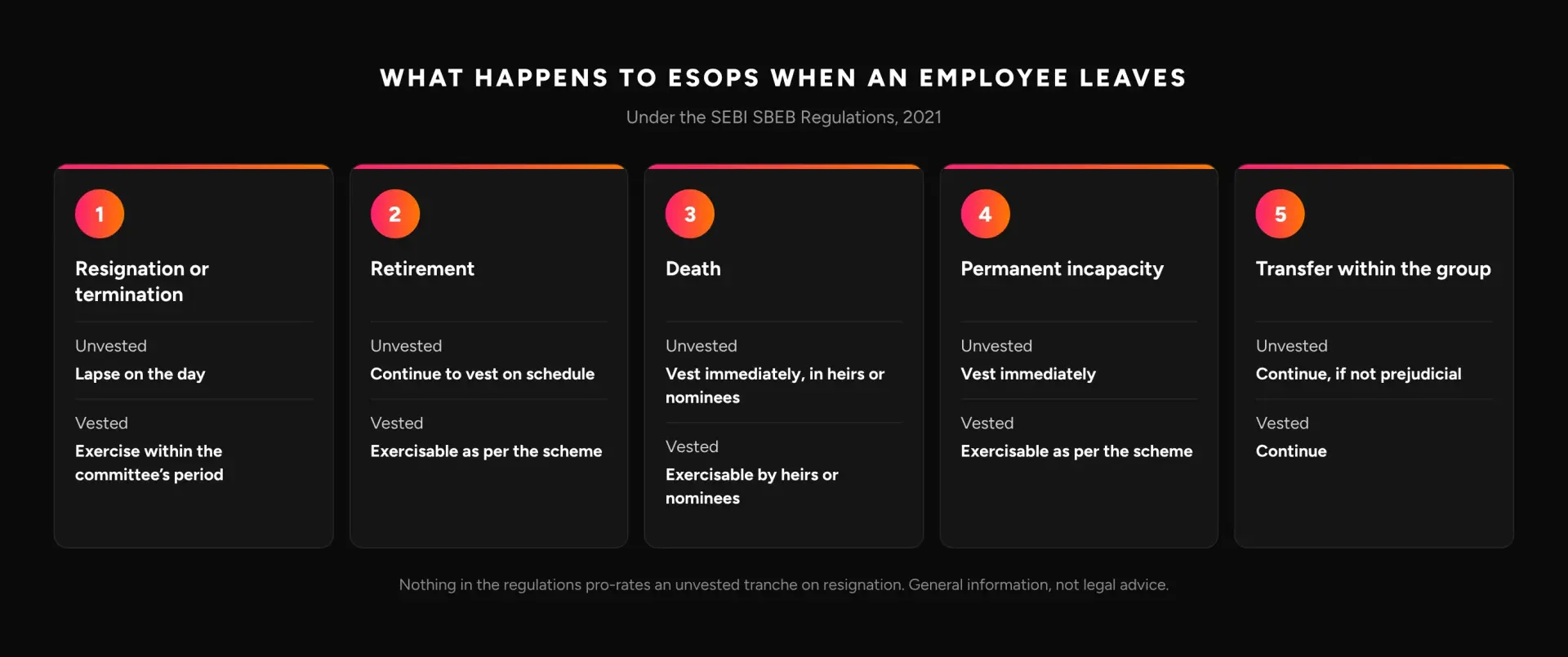
The resignation row generates the most difficult conversations. An employee who resigns three months before a vesting date loses that whole tranche. Nothing in the regulations pro-rates it, and the scheme usually doesn't either. Say this clearly at grant, not in the exit interview.
What must be disclosed?
- Board's report: The details set out in Part F of Schedule I (Regulation 14), such as:
- options granted, vested, exercised and lapsed
- the pricing formula
- the accounting impact
- Secretarial auditor certificate: Placed before shareholders at each AGM, confirming the schemes comply with the regulations and the shareholders' resolution (Regulation 13).
- Accounting: Under Ind AS 102 and the Institute of Chartered Accountants of India's guidance note on share-based payments (Regulation 15).
- Insider trading: Designated persons remain bound by SEBI's insider trading rules. Exercising options is generally allowed during a closed trading window. Selling the resulting shares isn't.
ESOPs granted before the IPO
A company that lists can keep using a pre-IPO scheme for new grants, but only if two conditions are met (Regulation 12):
- the scheme conforms to the SBEB Regulations
- shareholders ratify it after the IPO, before any new grant
Options already granted before the IPO can be exercised after listing, and the shares are listed on exercise (Regulation 11).
Shares allotted to employees under a compliant pre-IPO scheme are generally exempt from the six-month pre-IPO lock-in under Regulation 17 of the SEBI ICDR Regulations, 2018. Raise this with the merchant banker early. A scheme that doesn't conform loses the exemption, and employees find out at the worst possible moment.
Myths listed companies believe
Myth 1: A pre-IPO scheme carries on unchanged after listing
Fact: New grants need the scheme to conform to the SBEB Regulations, and to be ratified by shareholders after the IPO.
Myth 2: The trust can buy whatever it needs from the market
Fact: No more than 2% of paid-up capital a year and 5% in total, with a six-month minimum holding.
Myth 3: Promoters can never hold ESOPs
Fact: Since September 2025, founders named as promoters can keep and exercise benefits granted at least a year before the IPO filing. New grants are still off limits.
Myth 4: Trustees vote the trust's shares with management
Fact: Trustees can't vote shares held by the trust at all.
Myth 5: All options lapse when someone leaves
Fact: Only unvested options lapse on resignation or termination. Vested options can be exercised within the period set by the committee, and on retirement vesting continues on schedule.
Myth 6: Varying a scheme only needs a board decision
Fact: A variation needs a special resolution and must not hurt employees, unless it's required by law.
Running SBEB compliance in practice
Spreadsheets hold up for the first scheme. By the third scheme and the second trust tranche, they don't. The failures look small on the day and large in the auditor's report:
- a trust that crosses the 2% annual limit because two purchases were booked in different files
- an inventory deadline nobody put in the diary
- Part F numbers that disagree with the grant register
Four habits prevent most of this:
- Keep one register of every grant, vesting, exercise, lapse and transfer, by scheme.
- Check trust purchases against the 2% and 5% limits after every trade, not at year end.
- Diarise unappropriated inventory deadlines and closed trading windows.
- Produce the Part F disclosure from the same data the auditors test.
An ESOP platform built for listed companies keeps all of this in one record, alongside the cap table and corporate actions. For the decisions that stay with the board, see what to do when a key employee asks for accelerated vesting.
Frequently asked questions
1. Do the SEBI SBEB Regulations apply to unlisted companies?
No. Unlisted companies follow Section 62(1)(b) of the Companies Act, 2013 and Rule 12 of the Share Capital and Debentures Rules. The SBEB Regulations apply once the company is listed, including to pre-IPO schemes it wants to keep using.
2. What is the minimum vesting period under the SBEB Regulations?
One year from grant, for both options and SARs. The exceptions are death, permanent incapacity and options substituted after a merger.
3. Can promoters get ESOPs in a listed company?
Not new grants. Since 8 September 2025, founders named as promoters in an IPO filing can keep and exercise benefits granted at least a year before the filing.
4. Is an ESOP trust mandatory for listed companies?
Only if the scheme buys existing shares on the market. A company issuing new shares can run its scheme directly.
5. How much can an ESOP trust buy from the market?
Up to 2% of paid-up equity capital in a financial year. In total, it can hold up to:
- 5% for ESOS, ESPS and SAR schemes
- 2% for GEBS and RBS
- 5% across all schemes
6. Are RSUs covered by the SBEB Regulations?
Yes, in practice. RSUs aren't a separate category, so listed companies usually grant them as options with a nominal exercise price under an ESOS.
7. How do you change the terms of a listed company ESOP scheme?
By special resolution of shareholders, and only if the change doesn't hurt employees. Changes needed to meet a legal requirement don't need shareholder approval.
8. What happens to ESOPs when an employee retires?
Under Regulation 9(6), retirement isn't treated as leaving. Options continue to vest on their schedule, as the scheme sets out.
This article is general information, not legal, tax or accounting advice. It reflects the SBEB Regulations as amended up to December 2025. Speak to a company secretary, legal counsel and auditor before designing or changing a scheme.
Stay SBEB-ready without the spreadsheets
Tallect keeps grants, vesting, trust holdings and Part F disclosure data in one record built for listed companies, with experts on call.