
Phantom Stock vs SARs vs ESOPs: Which Equity Plan Fits Your Company?
Three ways to share the upside: how phantom stock, stock appreciation rights and ESOPs differ on cash, dilution, tax and accounting.
Founders often ask for phantom stock because it sounds simpler than ESOPs. Sometimes it is. More often, it moves the complexity from the cap table to the cash flow statement, and the bill arrives in the year the company has done best.
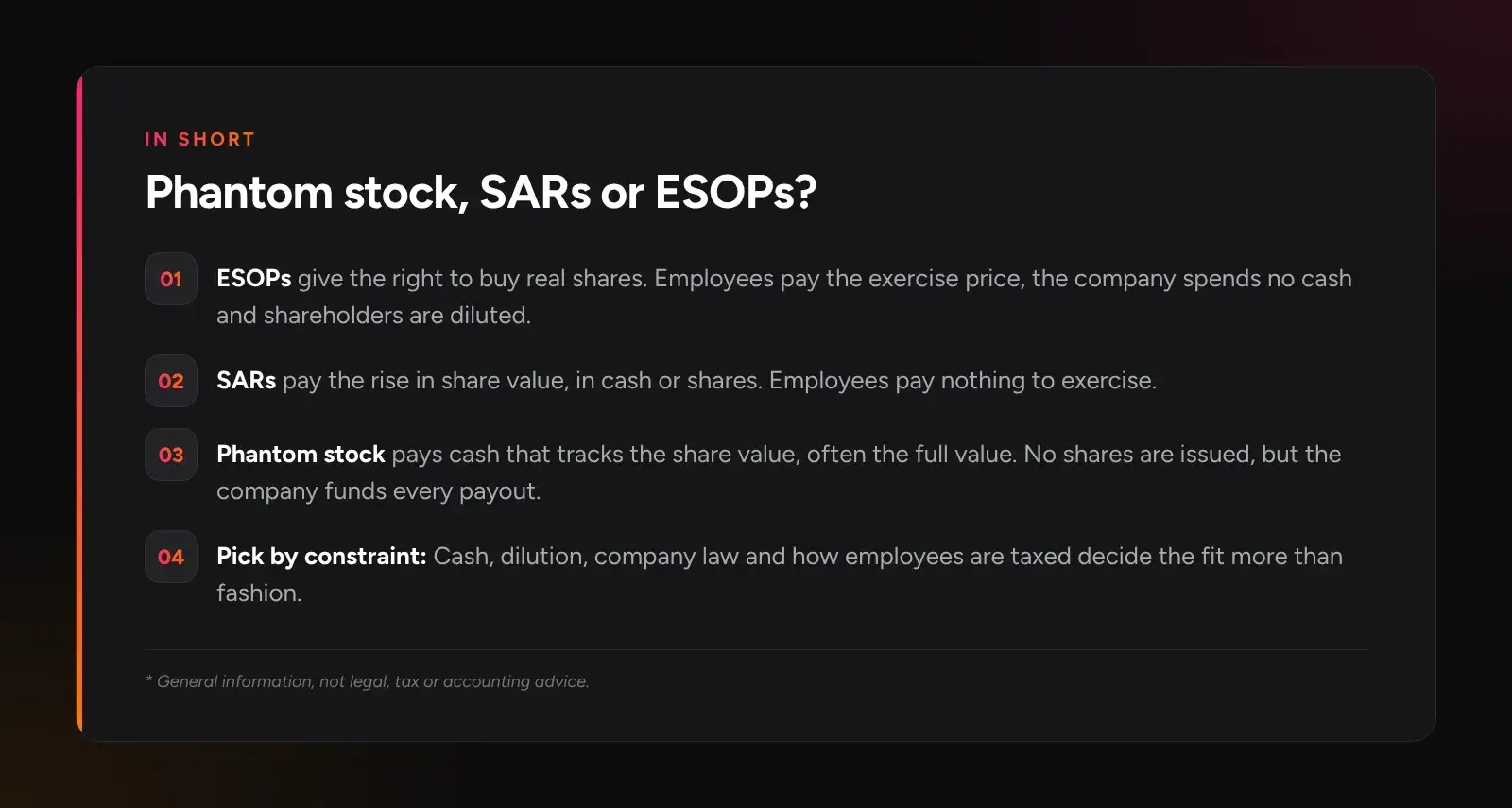
The short version:
- An ESOP gives the right to buy real shares at a fixed price. The employee pays to exercise and becomes a shareholder.
- A stock appreciation right (SAR) pays the rise in share value, in cash or in shares, with nothing to pay upfront.
- Phantom stock pays cash that tracks the share value, often the full value, and no shares change hands.
Each suits a different company:
- ESOPs suit companies that want real ownership without spending cash.
- SARs suit companies that want employees to share the upside without paying to exercise.
- Phantom stock suits companies that can't or won't issue shares, and can fund the payouts.
What are ESOPs, SARs and phantom stock?
- ESOP (employee stock option): The right to buy a set number of shares at a fixed exercise price once they vest. The employee pays the exercise price and owns real shares.
- SAR (stock appreciation right): The right to receive the increase in share value above a base price, on a set number of shares. A cash-settled SAR pays cash. An equity-settled SAR pays the same value in shares.
- Phantom stock: A promise to pay cash equal to the value of a set number of notional shares, at a set date or event. It comes in two forms:
- Appreciation-only plans pay the increase in value, much like a cash SAR.
- Full-value plans pay the whole value of the notional shares.
Particulars | ESOP | SAR | Phantom stock |
|---|---|---|---|
What the employee receives | Real shares | Cash or shares worth the increase | Cash worth the increase, or the full value |
Employee pays to exercise | Yes, the exercise price | No | No |
Shareholder rights | Yes, after exercise | Only if settled in shares | No |
New shares issued | Yes | Fewer, and only if settled in shares | None |
Company cash out | None; it receives the exercise price | Yes, if settled in cash | Yes, always |
Value if the share price falls below the grant price | Nothing | Nothing | Nothing for appreciation-only; the reduced value for full-value |
Caption: ESOPs, SARs and phantom stock compared at a glance.
How the payouts compare
Take one employee and 10,000 units of each plan. The share value at grant is USD 1.00. Four years later, at payout, it's USD 3.00.
Particulars | ESOP | Cash-settled SAR | Full-value phantom stock |
|---|---|---|---|
Employee pays | USD 10,000 to exercise | Nothing | Nothing |
Employee receives | 10,000 shares worth USD 30,000 | USD 20,000 in cash | USD 30,000 in cash |
Employee's gain | USD 20,000 | USD 20,000 | USD 30,000 |
Company's cash | Receives USD 10,000 | Pays USD 20,000 | Pays USD 30,000 |
New shares issued | 10,000 | None (6,667 if settled in shares) | None |
If the value falls to USD 0.80 | Worth nothing | Worth nothing | USD 8,000 |
Caption: Illustrative example before tax: 10,000 units, grant value USD 1.00, payout value USD 3.00.
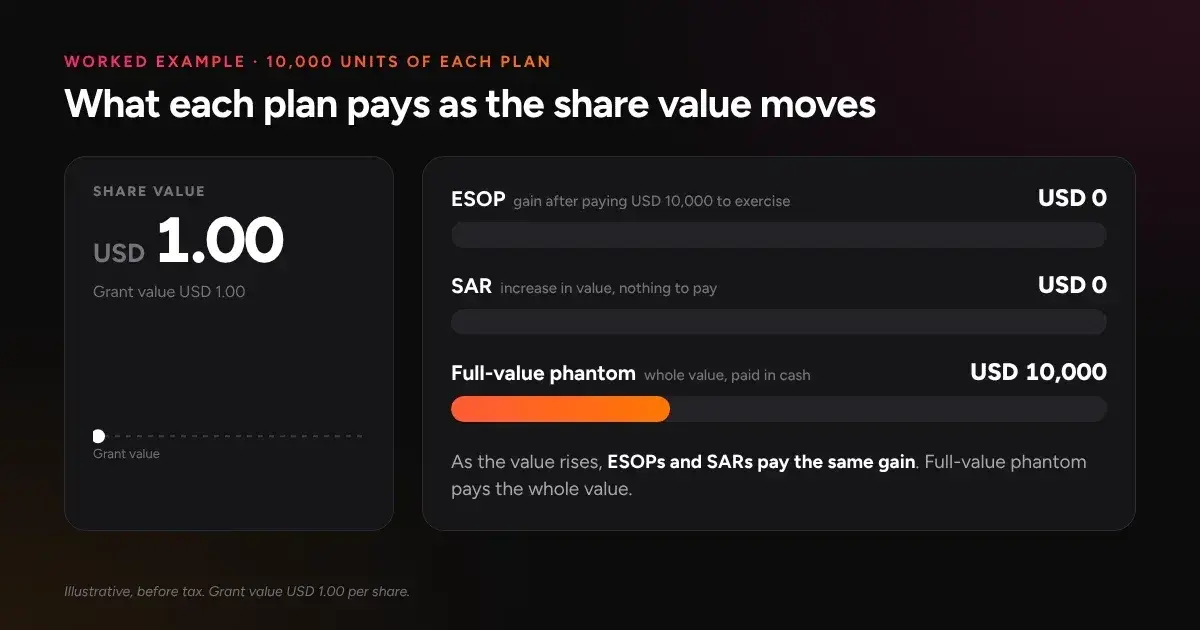
Two things stand out:
- ESOPs and SARs deliver the same gain on the same number of units. But the SAR asks nothing of the employee, and the ESOP brings cash into the company.
- A full-value unit is worth more than an appreciation unit, and keeps some value even when the price falls. So for the same target reward, a full-value grant should be smaller.
Granting full-value units in the same number as options is one of the most expensive design mistakes in this area.
Which plan costs the company more?
The cost shows up in three places: cash, dilution and the profit and loss account.
- Cash: Phantom stock and cash-settled SARs are paid from the company's cash, and the bill is largest when the company has done best. ESOPs cost no cash and bring in the exercise price.
- Dilution: ESOPs issue a new share for every option exercised. Equity-settled SARs issue only enough shares to cover the gain. Phantom stock issues none. See how options enter the fully diluted share count.
- Accounting: IFRS 2, Ind AS 102 and US GAAP treat the two kinds of award differently:
A rising share price means a rising expense, and reported profit moves with the valuation. - Equity-settled awards are measured at fair value on the grant date and not remeasured.
- Cash-settled awards are a liability, remeasured at every reporting date until they're paid, with each change going through profit and loss.
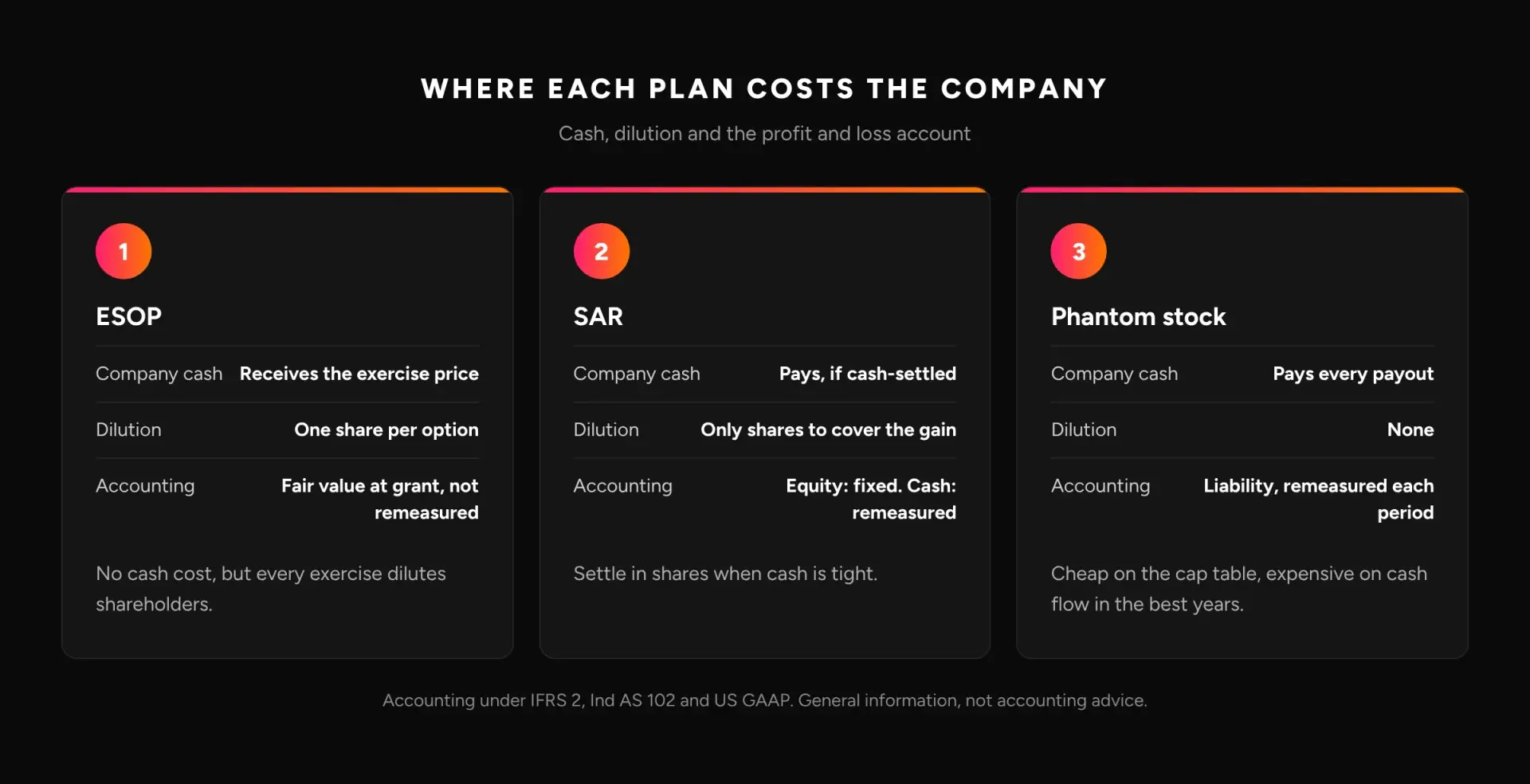
Phantom stock looks cheap on the cap table and expensive on the cash flow statement.
CFOs tend to notice the accounting first. In a good year, the phantom liability can grow faster than profit. Then a board that approved "a simple cash plan" finds itself explaining the swing to investors. Model the payout at two and three times today's valuation before the plan is signed.
How are they taxed?
Tax follows the employee's country, not the company's. The broad pattern:
Country | ESOP | SAR | Phantom stock |
|---|---|---|---|
India | Salary on exercise, on fair market value minus exercise price; capital gains on sale | Salary on payout or exercise, whether in cash or shares | Salary on payout |
US | Non-qualified options: ordinary income on exercise. Incentive stock options: no regular tax on exercise, and capital gains if holding periods are met | Ordinary income on exercise | Ordinary income on payout, and usually subject to Section 409A |
UK | Unapproved options: income tax on exercise. EMI options: usually no income tax on exercise if granted at market value; capital gains tax on sale | Income tax and National Insurance on payout | Income tax and National Insurance on payout |
UAE | No personal income tax | No personal income tax | No personal income tax |
Caption: How each plan is broadly taxed for the employee, by country.
India
An ESOP is taxed twice:
- As salary when it's exercised.
- As capital gains when the shares are sold, with the value taxed at exercise as the cost.
Eligible startups can defer the tax deducted at exercise until the earliest of three events (Section 392(3) of the Income-tax Act, 2025):
- a sale
- the employee leaving
- 60 months from the end of the tax year
SAR and phantom payouts are taxed in full as salary in the year they're paid, with tax deducted at source. That's simpler, but it gives up the lower long-term capital gains rate on future growth. For a senior employee on the top slab, the difference on a large payout is significant.
US
A SAR is generally exempt from Section 409A if its base price is never below fair market value on the grant date and it covers a fixed number of shares.
Phantom stock usually isn't exempt. It must pay on a fixed date or a permitted event, such as:
- leaving
- a change of control
- a set schedule
A plan that breaks Section 409A makes the vested amount taxable at once, with an extra 20% tax (The Tax Adviser). This is the single most common reason a phantom plan drafted outside the US needs reworking before US employees join it.
UAE and Saudi Arabia
Neither country taxes employment income, so the choice turns on company law and cash.
In the UAE, a mainland LLC is limited to 50 shareholders, and existing partners have pre-emption rights. That makes direct equity for many employees impractical. Phantom shares avoid both. Companies that want real equity often grant it through a holding company in the DIFC or ADGM (Kayrouz and Associates).
Take a Dubai mainland LLC with 40 employees that wants to reward its top 15. Making all 15 shareholders would use up most of the 50-shareholder limit, and give the existing partners a say in every allotment. A phantom plan rewards the same 15 people without touching either.
Gulf boards have also traditionally preferred cash. In 2025, 56.5% of CEOs in Saudi Arabia received long-term incentives, against about 35% in the UAE (Cooper Fitch).
How do employees see each plan?
How employees see it | ESOP | SAR | Phantom stock |
|---|---|---|---|
Feels like ownership | Strongly | Somewhat | Least |
Cash needed to benefit | Exercise price and tax | Tax only | Tax only |
Can turn into cash | Only at a buyback, sale or IPO | On exercise, if cash-settled | On the payout date |
Easy to understand | Takes explaining | Fairly easy | Easiest |
Risk if the company stalls | Options can be worthless | Can be worthless | Full-value units keep some value |
Caption: How employees tend to see each plan.
The questions employees ask give the game away:
- With ESOPs, it's almost always "Where do I find the money to exercise?"
- With phantom stock, it's "How do you work out what a unit is worth?"
The second is easier to answer, but only if the valuation method is written down and applied the same way every year.
Whichever plan you pick, employees value it only when they understand it. See how to communicate ESOPs to employees.
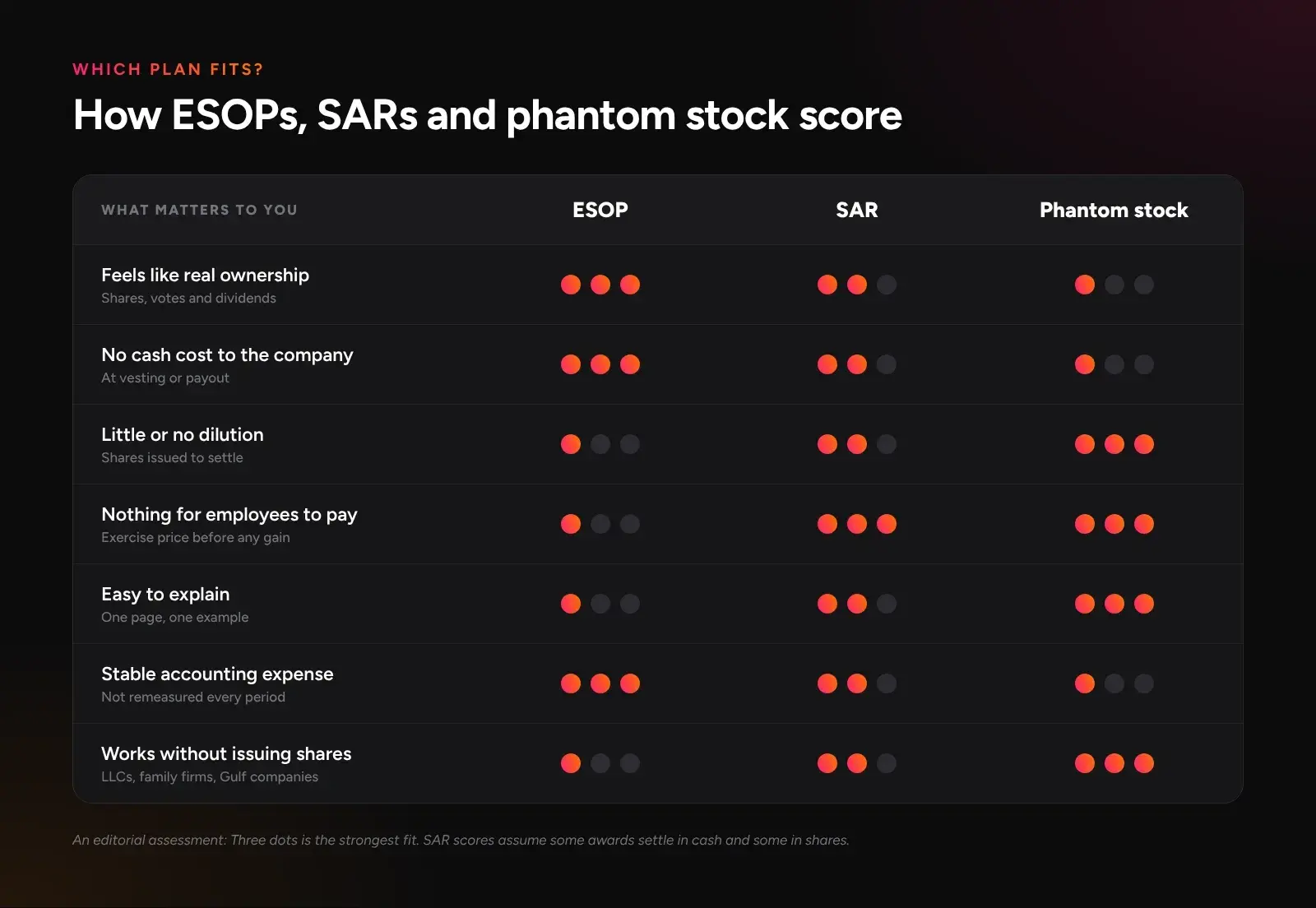
Which plan fits your company?
For most venture-backed startups, ESOPs remain the right default. Cash is scarce, investors expect an option pool and employees understand ownership.
Phantom stock earns its place in narrower cases:
- a company that can't easily issue shares
- a subsidiary whose own shares mean little to its staff
- a handful of senior people the company wants to reward without changing the cap table
If your company... | Consider |
|---|---|
Is a startup with little cash and wants employees to think like owners | ESOPs |
Wants upside for employees without asking them to pay an exercise price | SARs, settled in shares if cash is tight |
Is an LLC, a family business or in a market where issuing shares is hard | Phantom stock |
Wants to reward a few senior people without changing the cap table | Phantom stock or cash-settled SARs |
Expects a sale or IPO and wants to pay out only then | ESOPs, or phantom stock that pays on exit |
Has employees in several countries | One plan with country sub-plans, or ESOPs in some countries and phantom units in others |
Caption: Which plan to consider, depending on your company's situation.
Can you combine or switch plans?
Yes. Many groups run ESOPs where issuing shares is easy and the tax treatment is favourable, and phantom or cash SAR plans where it isn't. A common pattern is equity for the core team and phantom units for a subsidiary, or for a market where shares can't be issued locally.
Switching later is possible but rarely clean. Converting phantom units into real equity before an IPO or sale raises tax and accounting questions, and in the US, Section 409A questions too. Before you convert:
- price the conversion
- take advice
- document it as a formal change to the plan
If a conversion is likely, it's far cheaper to design for it on day one.
How to set up a phantom or SAR plan
- Define the unit value: A valuation formula or an independent valuation, applied the same way every time.
- Choose appreciation-only or full value, and set the base price.
- Set the vesting and payout triggers: Time, performance, a sale or a fixed date.
- Write the leaver rules: What good and bad leavers keep, and when they're paid.
- Plan the funding: Model the payout under several share prices, and set cash aside.
- Document it: A board-approved plan and an award letter for each employee. In India, check whether the SAR plan involves shares, because equity-settled SARs follow the share issue rules.
- Keep a register: Units granted, vested, paid and lapsed, with the valuation used each time.
Step 4 causes the most disputes. Picture an employee who leaves three months before a payout date, with units that are fully vested. Is she paid now, at the normal date or not at all? If the plan doesn't say, expect an argument. Write the answer down.
Run phantom units through the same system as ESOPs, so the board sees one picture of everything it has promised.
Frequently asked questions
1. Is phantom stock better than ESOPs?
Neither is better in general:
- Phantom stock avoids dilution and suits companies that can't issue shares. But it costs cash, and in most countries it's taxed fully as income.
- ESOPs cost no cash and give real ownership, but they dilute shareholders.
2. Are SARs the same as phantom stock?
Not quite:
- A SAR pays only the increase in value, and can be settled in cash or shares.
- Phantom stock is always cash, and can pay the full value.
A cash-settled SAR and an appreciation-only phantom plan work almost the same way.
3. Do phantom shares dilute existing shareholders?
No. No shares are issued, so ownership doesn't change. The cost is the cash paid out instead.
4. How is phantom stock taxed in India?
The whole payout is salary in the year it's paid, taxed at the employee's slab rate, with tax deducted by the employer. There's no capital gains treatment.
5. Can a private limited company in India offer SARs?
Yes. The Companies Act doesn't deal with SARs specifically:
- A cash-settled SAR is a contractual bonus.
- An equity-settled SAR involves issuing shares, so it's usually structured within an ESOP scheme approved under Section 62(1)(b) and Rule 12.
6. What happens to phantom stock when an employee leaves?
The plan decides. Unvested units usually lapse. Vested units may be:
- paid at leaving
- paid at the normal date
- forfeited, for a bad leaver
7. Are phantom shares common in the UAE and Saudi Arabia?
Yes. Gulf companies have long favoured cash-based long-term incentives, and phantom plans avoid the company law limits on issuing shares to many employees.
8. What is a full-value phantom share?
A unit that pays the whole value of one share at payout, not just the increase since grant. It's worth more than an appreciation unit, so companies grant fewer of them.
This article is general information, not legal, tax or accounting advice. The examples are simplified and ignore tax. Speak to a lawyer, tax adviser and auditor before choosing or changing an incentive plan.
Run ESOPs, SARs and phantom units in one place
Tallect tracks every plan, valuation and payout across countries, so your board sees one picture of everything it has promised.
![Run ESOPs, SARs and phantom units in one place, with a Book a demo button.]](/img/1920/75/api/media/file/phantom-stock-sar-esop-cta.webp)