11 Best Flexible Benefits Platforms for 2027: An Honest Buyer's Guide
A fair comparison of 11 flexible benefits platforms across global, UK, Australian, US and UAE markets, plus how to choose one.
A flexible benefits platform is software that lets employees choose or allocate benefits from a set budget or menu. HR uses it to run the eligibility rules, allowances, claims and reporting behind those choices.
Instead of giving everyone the same fixed package, the employer sets the rules and the money. Each employee then picks what fits their life, such as:
- more health cover
- a wellbeing budget
- a pension top-up
- a home-working allowance
Many employers are reviewing these platforms ahead of their 2027 plan year, for three reasons:
- workforces are spread across more countries
- employees expect benefits they can tailor
- finance teams want a clear view of what benefits really cost
A platform that worked well for one office can struggle when the same programme has to run in several countries, with different currencies, payroll systems, insurers and rules.
This guide compares 11 platforms:
- two global platforms: Benifex and Darwin
- the Benefits & Insurance module from Tallect
- two platforms from each of four markets: the UK, Australia, the US and the UAE
We chose platforms by market because flexible benefits work differently in each one. A UK scheme built on salary sacrifice, an Australian salary packaging programme and a US lifestyle spending account solve different problems. A fair comparison needs local specialists alongside the global players.
A plain disclosure before you read further: Tallect publishes this guide, and its Benefits & Insurance module is one of the 11 platforms reviewed.
- Every platform gets the same format, including a section on where it may not be the best fit.
- Every feature, price and coverage figure comes from the vendors' own public information or news coverage.
- Country, user and client figures are the vendors' own claims, so check them with each vendor before you decide.
What a flexible benefits platform does
At its core, a flexible benefits platform does four jobs:
- It holds the rules: who is eligible for what, how much budget each person gets, and when they can change their choices.
- It gives employees one place to see their options and make choices.
- It handles the money, through claims, reimbursement, cards or payroll deductions.
- It reports back to HR and finance on take-up and spend.
Platforms differ in which of these jobs they do best. Most fall into one of four types.
Type | What it does | Best for | Main limitation |
|---|---|---|---|
Global flex and total rewards platforms | Run benefits, allowances and often insurance across many countries from one system, sometimes alongside pay and recognition | Multinationals that want one employee experience and one view of spend | Local benefit depth can vary by country, so check each market |
Allowance and card platforms | Give employees budgets or stipends that they spend on a benefits card or claim back | Distributed teams that want simple, flexible allowances | Insured benefits and pensions may sit outside the platform |
Salary packaging providers | Run programmes where part of pay is restructured into benefits, often as a managed service | Employers in one market with a strong local packaging system | Usually tied to one country's rules |
HR-and-benefits suites | Combine HR administration, payroll, insurance and benefits | Employers in one region that want fewer systems | Flexible benefits may be less deep than in a dedicated platform |
Caption: The four main types of flexible benefits platform.
The right type depends on where your people are and what you want benefits to do. A company with small teams in 20 countries has different needs from one with 2,000 employees in a single market, even if their total headcount is similar.
How flexible benefits differ by market
The same idea, giving employees choice within a budget, runs on different mechanisms in each of the four markets in this guide.
- UK: Flexible benefits schemes often use salary sacrifice, where an employee gives up part of their pay in exchange for a benefit, such as a higher pension contribution. UK platforms usually handle pension rules and show employees how each choice affects take-home pay.
- Australia: Salary packaging lets employees receive certain benefits as part of their pay package instead of as cash salary.
- Novated leasing is a common form. A car lease is paid through payroll, under an agreement between the employee, the employer and a finance company.
- Fringe benefits tax (FBT) is a tax employers pay on certain non-cash benefits. Some sectors get different FBT treatment.
- US: Three kinds of account are common:
- Pre-tax accounts, which employees fund from pay before tax.
- Lifestyle spending accounts (LSAs), which are employer-funded allowances for things such as fitness, wellbeing or learning.
- Health Reimbursement Arrangements (HRAs), another employer-funded account, used for health costs.
- UAE: Benefits are often led by health insurance, with perks, discounts and wellness programmes added on top.
Tax treatment of each of these varies by country and can change. Check local requirements and take advice before you design or change a programme.
How we evaluated each platform
We looked at each platform against 10 criteria that matter to HR, benefits and finance teams. We did not score the platforms, because the right weighting depends on your countries, workforce and goals. Use these criteria to build your own scorecard and weight them for your situation.
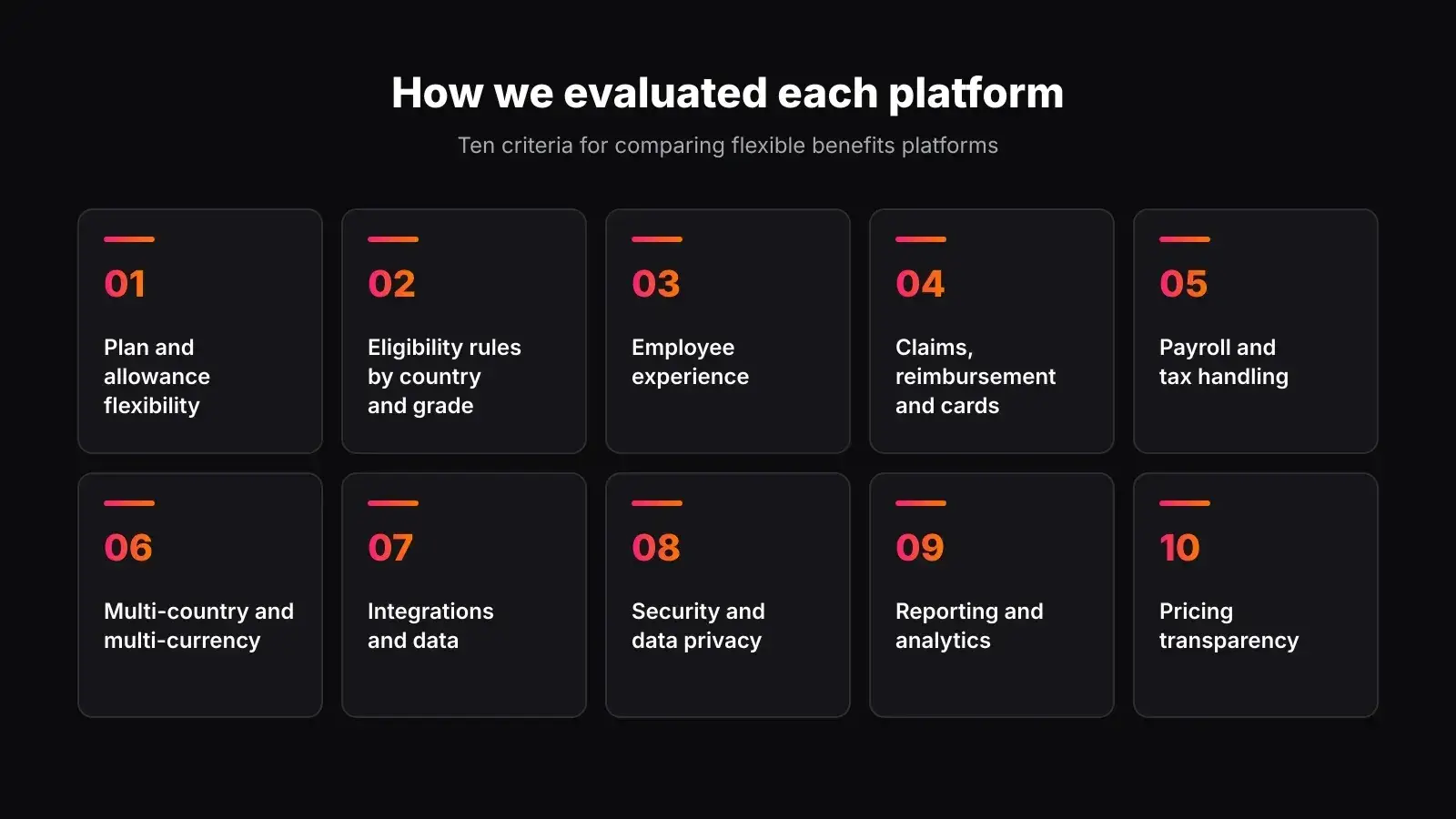
Plan and allowance flexibility
Good looks like this: you can set up different plan designs without custom development, such as:
- fixed benefits
- a budget-based menu
- cash allowances
Budgets can be one-off or recurring. You can change them for the next plan year without rebuilding the programme.
Eligibility rules by country and grade
Good looks like this: rules for who gets what can use location, grade, contract type, length of service and salary. They apply automatically when an employee joins, moves country or is promoted. You should not need spreadsheets to manage exceptions.
Employee experience
Good looks like this: employees can:
- see all their benefits in one place
- understand what each choice means for them
- change their choices on a phone in a few steps
Help is available in their language, and benefits are explained in plain words.
Claims, reimbursement and cards
Good looks like this: employees can claim against allowances quickly, approvals follow clear rules, and money reaches them through payroll or a card.
If the platform uses a card, check:
- where it works
- which purchases it accepts
- how currency is handled
Payroll and tax handling
Good looks like this: deductions, allowances and taxable amounts flow to payroll accurately, and reconciliation does not need manual fixes each cycle. The platform should support local treatment, but your tax and payroll advisers still confirm the rules in each country.
Multi-country and multi-currency support
Good looks like this: one programme can run across your countries with local benefits, local currencies and local languages, while HR still sees a consolidated global view. Ask for the list of countries where the platform supports local benefits, not just payments.
Integrations and data
Good looks like this: connections to your HR system, payroll, insurers and benefit providers keep employee data in sync without double entry. Ask:
- which integrations are ready-made
- which are custom
- who maintains them
Security and data privacy
Good looks like this: the vendor can show independent certifications, and can explain:
- where data is stored
- who can see it
- how access is controlled
Benefits data can include health and family details, so treat this criterion as a gate, not a nice-to-have.
Reporting and analytics
Good looks like this: HR and finance can see take-up, spend against budget and trends by country, grade or employee group. They can also export data for their own analysis. Good reporting helps you spot benefits nobody uses, and gaps between groups.
Pricing transparency
Good looks like this: the vendor explains:
- what you pay for
- what drives the price up
- which costs sit outside the core fee
A written quote that covers implementation, modules and transaction fees makes it much easier to compare platforms fairly.
Platforms at a glance
This table gives a short view of each platform, in the order the entries appear below. Coverage figures are the vendors' own claims unless marked otherwise.
Platform | Home market | Best for | Coverage | One thing to check |
|---|---|---|---|---|
Zest | UK | UK employers that want pension, salary sacrifice and allowances in one scheme | UK focus | Fit for employees outside the UK |
Tallect | Global | Benefits, insurance and policies managed together within total rewards | Global programmes; no country count published | Supported countries and currencies for your footprint |
MyBenefits | UAE | MENA employers standardising discounts, flexible benefits and wellness | 13 MENA countries (reported in 2023) | Current country coverage |
Maxxia | Australia | Managed salary packaging and novated leasing | Australia | What fees employees pay |
Forma | US | Lifestyle and other spending accounts on one platform | 100+ countries | Which account types apply outside the US |
Flare | Australia | Benefits, salary packaging and onboarding with no platform fee | Australia | How the no-fee model is funded |
Darwin | Global | Large multinationals that want software plus broking and consulting | Over 100 countries, 43 languages | Whether you also need consulting or broking |
Benifex | Global | Multinationals that want one experience plus a full-service model | More than 100 countries | Pricing for the full platform |
Benepass | US | Card-first flexible benefits and stipends | Benefits used in over 200 countries | Which benefit types work outside the US |
Ben | UK | Multi-country teams that want allowances, a marketplace and insured benefits | 140+ countries | Which countries have local insured benefits |
Bayzat | UAE | UAE and Saudi employers that want HR, payroll, insurance and benefits together | UAE and Saudi Arabia | How far flexible benefits go beyond insurance and perks |
Caption: Coverage figures are each vendor's own published claims and have not been independently verified. The MyBenefits figure comes from 2023 news coverage.
How platforms are priced
Few flexible benefits vendors publish their prices. Of the 11 platforms in this guide, only one publishes a starting price, and only for one module. Most share pricing after a discovery call, so it is important to understand the common pricing models before you compare quotes.
Model | How it works | What to watch for |
|---|---|---|
Per employee per month (PEPM) | A fee for each eligible or enrolled employee, billed monthly or annually | Whether you pay for all eligible staff or only those who enrol, and any minimum fee |
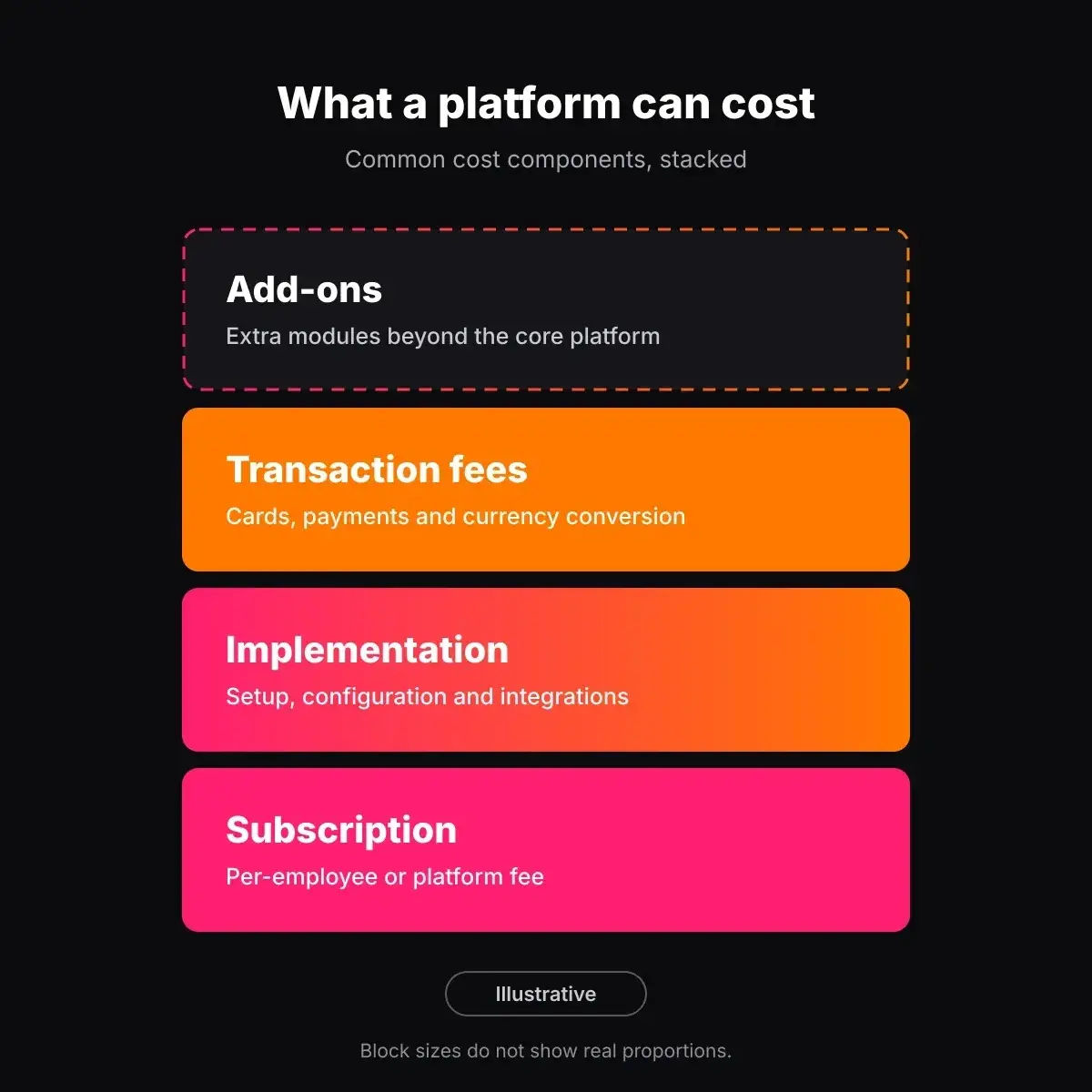
Platform or implementation fees | A set-up charge or annual platform charge on top of user fees | What implementation covers, such as configuration, integrations and data migration |
Transaction or card fees | Charges for card issuing, payments, currency conversion or reimbursements | Who pays them, the employer or the employee, and how they grow with use |
Add-on modules | Extra charges for features such as recognition, insurance administration or analytics | Which features shown in the demo are part of the core price |
Employee-paid or no-fee models | The employer pays little or nothing, and the provider earns from employee-side products or fees | How the provider is funded and what employees end up paying |
Caption: Common pricing models for flexible benefits platforms.
Several factors tend to push the cost up:
- the number of countries in scope
- the number of benefits and providers
- complex eligibility rules
- custom integrations
- managed services, such as administration or employee communication
- the level of employee support you need, such as extended hours or more languages
Hidden costs are the ones that do not appear on the first quote. Check these before you sign:
- internal time from HR, payroll, IT and finance during implementation
- changes your payroll provider, insurers or brokers may charge for
- price increases at renewal
- currency conversion on allowances paid in several currencies
- data export and exit support at the end of the contract
To compare like with like, build a simple total cost model. For example, a company with 1,000 eligible employees and an annual flex allowance of $1,500 per employee would fund $1,500,000 a year in allowances (illustrative figures only). Platform, implementation and transaction costs then sit on top of that allowance budget. Ask each vendor to price the same scenario over the full contract term.
The 11 platforms reviewed
The entries below run in reverse alphabetical order. This is not a ranking. Each entry uses the same five parts:
- who it suits
- key strengths
- coverage
- where it may not be the best fit
- pricing
Features, figures and pricing come from each vendor's public pages or news coverage, so confirm the details with the vendor before you decide.
Zest (UK)
Who it suits. UK employers that want a flexible benefits scheme, with pension, salary sacrifice and allowances, on one platform.
Key strengths.
- Employees see all their benefits in one place. They can change choices at any time, or in benefits windows the employer controls.
- A Total Reward Statement shows how choices affect tax, National Insurance (the UK's social security contribution), employer contributions and take-home pay.
- Pension flex, plus what Zest calls "SMART" salary sacrifice.
- Personal allowances, such as wellbeing or home-working budgets. Employees claim against them, with employer approval before reimbursement through payroll.
- Admin rules control access to each pension scheme by role, length of service, location or salary, with auto-enrolment compliance tools built for UK pension rules.
- An AI Benefit Consultant for employee questions, a mobile app, wellbeing content, peer recognition and employee discounts.
- Security certifications listed: Cyber Essentials Plus and ISO/IEC 27001.
Coverage. Zest focuses on the UK and lists no other countries. Features such as pension auto-enrolment compliance are built for UK rules.
Where it may not be the best fit. Employers with sizeable groups of employees outside the UK should check how Zest would cover them, or whether they would need another platform alongside it.
Pricing. Zest does not publish pricing. Ask for a quote based on your headcount and the features you need.
Tallect (Global)
Who it suits. Employers that want flexible benefits, insurance and benefit policies managed together, and want benefits shown as part of the total rewards package. Tallect is a total rewards platform with 10+ modules that customers can choose from. Benefits & Insurance is its benefits module.
Key strengths.
- Standard and Flex benefit options, with a spending account or wallet that gives employees flexibility and lets them manage their own choices.
- A globally consistent benefits framework that stays regionally compliant.
- Centralised budget and spend management, with a high degree of customisation.
- Benefits shown in the total rewards package, so the full benefit spend is visible.
- Insurance management:
- Standard, Modular or Flex insurance designs
- global insurance programmes managed from one place
- access to global brokers
- programme launch and enrolment
- life events and claims management
- history and trends to support premium negotiation
- Global employee policies: a central policy repository, global audit management, customised access control, and policies linked to benefits.
- Easy navigation and personalised benefits for employees.
- Certifications listed: SOC 2 Type II, SOC 1, GDPR, CCPA, ISO 27001 and ISO 27701. Tallect also lists integration with multiple systems and data sources.
Coverage. Tallect describes global programmes and a globally consistent, regionally compliant framework. It does not publish a count of supported countries or currencies.
Where it may not be the best fit. No country or currency list is published, so check that every country and currency in your footprint is supported before you shortlist. Also confirm which integrations your HR, payroll and insurance setup needs.
Pricing. Tallect does not publish prices. Pricing is shared on request.
MyBenefits (UAE)
Who it suits. Employers in the Middle East and North Africa (MENA) that want to standardise staff discounts, flexible benefits and wellness programmes across markets. This is the UAE-based MyBenefits. It is not the Romanian MyBenefits platform, or Benefit Systems' MyBenefit in Poland.
Key strengths.
- A SaaS platform for staff discounts, rewards and benefits.
- Flexible benefits and wellness initiatives that run across markets.
- A 2023 partnership with Xoxoday Empuls, which brought MyBenefits' perks catalogue into that employee engagement platform.
Coverage. News coverage reported MyBenefits in:
- nine MENA countries in 2021: the UAE, Bahrain, Kuwait, Saudi Arabia, Egypt, Lebanon, Jordan, Oman and Qatar
- thirteen MENA countries in 2023
These are older figures, so ask the vendor for current coverage.
Where it may not be the best fit. Employers with large teams outside MENA should check fit. It is also worth asking how far the platform goes beyond discounts and perks, for example into insured benefits or allowances with claims.
Pricing. MyBenefits does not publish pricing. Contact the vendor for a quote.
Maxxia (Australia)
Who it suits. Australian employers that want a managed salary packaging and novated leasing programme, including employers in sectors with special fringe benefits tax (FBT) treatment. Maxxia says it has more than three decades of experience as a salary packaging provider for Australian organisations.
Key strengths.
- Salary packaging and novated leasing, with benefits matched to the employer's sector, organisation and employees.
- Industry benchmarking and programme assessment, plus ongoing reporting on programme performance and participation.
- A dedicated payroll and finance support team and platform, and a relationship manager.
- Indemnity from unplanned FBT liabilities in some circumstances. The vendor's page does not say which.
- An online member portal with a rewards programme of everyday discounts.
Coverage. Australia.
Where it may not be the best fit. Maxxia is built around Australian salary packaging, so employers with staff in other countries should check how those employees would be covered. Ask which circumstances the FBT indemnity covers.
Pricing. Maxxia says it delivers its programme "at no additional cost to your organisation" and does not publish fees. Ask what fees employees pay.
Forma (US)
Who it suits. Mid-size to large employers, including global ones, that want lifestyle spending accounts and other spending accounts on one platform. Forma is based in San Francisco.
Key strengths.
- Lifestyle Spending Accounts (LSAs), pre-tax accounts and Health Reimbursement Arrangements (HRAs) in one benefits experience, with purpose-built wallets for each account type.
- Configurable account structures, funding levels and eligible categories per market.
- Country-level reporting alongside consolidated global visibility.
- Rewards & Recognition, launched in 2025.
- Forma states it is SOC 2 certified and GDPR compliant.
Coverage. Forma says it supports employees in 100+ countries, with localised currency and tax handling.
Where it may not be the best fit. Pre-tax accounts and HRAs are US arrangements. Employers with staff outside the US should check which account types apply to their people in each country.
Pricing. Forma does not publish pricing and offers custom pricing.
Flare (Australia)
Who it suits. Australian employers that want an employee benefits platform with salary packaging, discounts and onboarding, at no platform fee.
Key strengths.
- One employee app covering:
- pre- and post-tax benefits
- salary packaging, including car salary packaging (novated leasing)
- discounts
- wellness content
- digital onboarding
- Superannuation selection during onboarding. Superannuation is Australia's workplace retirement savings system.
- Integrations with most HRIS platforms, and with Australian applicant tracking, workforce management and payroll systems.
Coverage. Australia. Flare says more than 1.5 million employees across 100,000 businesses use its platform.
Where it may not be the best fit. Flare focuses on Australia, so check fit for employees in other countries. It is also worth understanding how the no-fee model is funded, for example through employee-side products such as leasing.
Pricing. Flare states there are "No SaaS or implementation fees" for employers. It publishes no price figures.
Darwin by Mercer Marsh Benefits (Global)
Who it suits. Large multinationals that want benefits software combined with broking and consulting from the same provider. Darwin was originally built by Thomsons Online Benefits in the UK. Mercer acquired Thomsons, and Darwin is now offered by Mercer Marsh Benefits.
Key strengths.
- One global platform with three "centres": for employees, administrators and decision makers.
- A Control Centre that lets benefits administration run in-house or inside an HR shared-service model.
- An Analytics Centre for data-driven insight, including checks for gaps such as gender gaps in the benefits offer.
- Integration with the HCM (human capital management) and payroll ecosystem.
Coverage. The vendor's pages give different country figures. The conservative reading is over 100 countries and 43 languages.
Where it may not be the best fit. Darwin suits buyers who value consulting and broking alongside software. If you want the software on its own, ask how the offer is structured. The vendor says Darwin does not have to be bought on a managed-service-only basis. Ask about the implementation timeline too.
Pricing. Not published. Ask for a quote that separates software from any consulting or broking services.
Benifex (Global)
Who it suits. Multinational mid-market and enterprise employers that want one benefits experience across many countries, plus a full-service model covering strategy, administration and communication. Benifex is headquartered in the UK, is part of Zellis Group, and was formed through a merger in February 2025.
Key strengths.
- OneHub brings benefits, wellbeing, reward and recognition into one place for employees.
- OneHub Wallet offers card-based flexible allowances.
- Integrations with other workplace systems.
- 24/7 employee support in over 100 languages.
- Benefit consulting and design services alongside the software.
Coverage. Benifex says it serves over 3,000 organisations in more than 100 countries.
Where it may not be the best fit. Check which local benefits are fully supported in each of your countries, and agree the implementation scope and timeline early.
Pricing. Core platform pricing is not published. The OneHub Wallet page lists a starting price "from as little as £2.00 per employee per month", with terms applying. That is the vendor's published starting price for the Wallet module only, not for the full platform.
Benepass (US)
Who it suits. Employers that want card-first flexible benefits and stipends, including for distributed international teams.
Key strengths.
- One platform and one card: a physical and virtual Visa card coded with the employer's benefits, including pre-tax benefits and perks programmes.
- Customisable benefits that the employer sets up once.
- A proprietary fintech platform.
- Automatic currency conversion for global users.
Coverage. Benepass says it has 400,000+ users, with 80+ countries represented among its clients and benefits used in over 200 countries.
Where it may not be the best fit. Pre-tax accounts are US arrangements. International employers should check which benefit types work in each country outside the US.
Pricing. Not published. Contact the vendor for pricing.
Ben (UK)
Who it suits. Employers with teams in many countries that want flexible allowances, a benefits marketplace and core insured benefits in one platform. Ben, also known as Thanks Ben, was founded in 2019, is headquartered in London, and describes itself as "AI-native".
Key strengths.
- Flexible spending allowances, one-off or recurring, spent on the Ben Mastercard.
- A configurable benefits marketplace, plus access to health and life insurance through Ben's broker network.
- Custom eligibility rules by location, contract type and more.
- Automated enrolment, reconciliation and payroll data, plus reporting on ROI and budget.
- Ben states it is ISO/IEC 27001 certified.
Coverage. Ben says it covers 140+ countries and 4,500+ benefit providers.
Where it may not be the best fit. Check which countries have local insured benefits as well as allowances, especially if insured cover matters in your main markets.
Pricing. Per-employee pricing, which the vendor describes as having no hidden fees. Prices are not published, so ask for the exact per-employee price and what it includes.
Bayzat (UAE)
Who it suits. UAE and Saudi employers that want HR, payroll, insurance and employee benefits on one platform. Bayzat is based in Dubai.
Key strengths.
- One platform built on four pillars: HR administration, payroll, insurance and employee benefits.
- Payroll processing directly from the platform.
- Health and wellness services for employees.
Coverage. The UAE and Saudi Arabia. Bayzat states the platform is fully compliant with Saudi labour laws.
Where it may not be the best fit. Employers with staff outside the Gulf should check fit. Bayzat is an HR-and-benefits suite, so it is also worth asking how far its flexible benefits go beyond insurance and perks.
Pricing. Not published on the pages we checked. Contact the vendor for pricing.
Where Tallect differs
This section is the publisher's own view. Tallect wrote it about its own platform, so read it with that in mind.
Across this list, we saw platforms built for different jobs, from single-market specialists to global suites. The table sets out common buyer needs, the patterns we saw, and how Tallect approaches each one.
Buyer need | What we saw across this list | Tallect's approach |
|---|---|---|
One programme across many countries | Several platforms focus on one market and its local rules | A globally consistent benefits framework that stays regionally compliant |
Benefits and insurance together | Some platforms centre on allowances and cards, with insurance offered through partners or kept separate | Insurance management with Standard, Modular or Flex designs, and global insurance programmes managed from one place |
Seeing the full cost of benefits | Reporting ranges from country-level views to consolidated global views | Benefits shown in the total rewards package, so the full benefit spend is visible |
Control over budgets | Budget tools differ by platform and account type | Centralised budget and spend management, with a high degree of customisation |
Policies linked to benefits | Few platforms on this list describe policy management as part of their benefits offer | A central policy repository, global audit management, customised access control and policies linked to benefits |
Employee choice | Most platforms offer some form of choice, through menus, wallets or cards | Standard and Flex options, a spending account or wallet, and employee self-managed choices |
Caption: The middle column summarises patterns across the platforms in this guide, based on their public information. The right column uses Tallect's own published description of its Benefits & Insurance module.
How to choose the right platform
Choosing a platform is easier when you decide what you need before you watch any demos. These steps work for most mid-size and enterprise buyers.
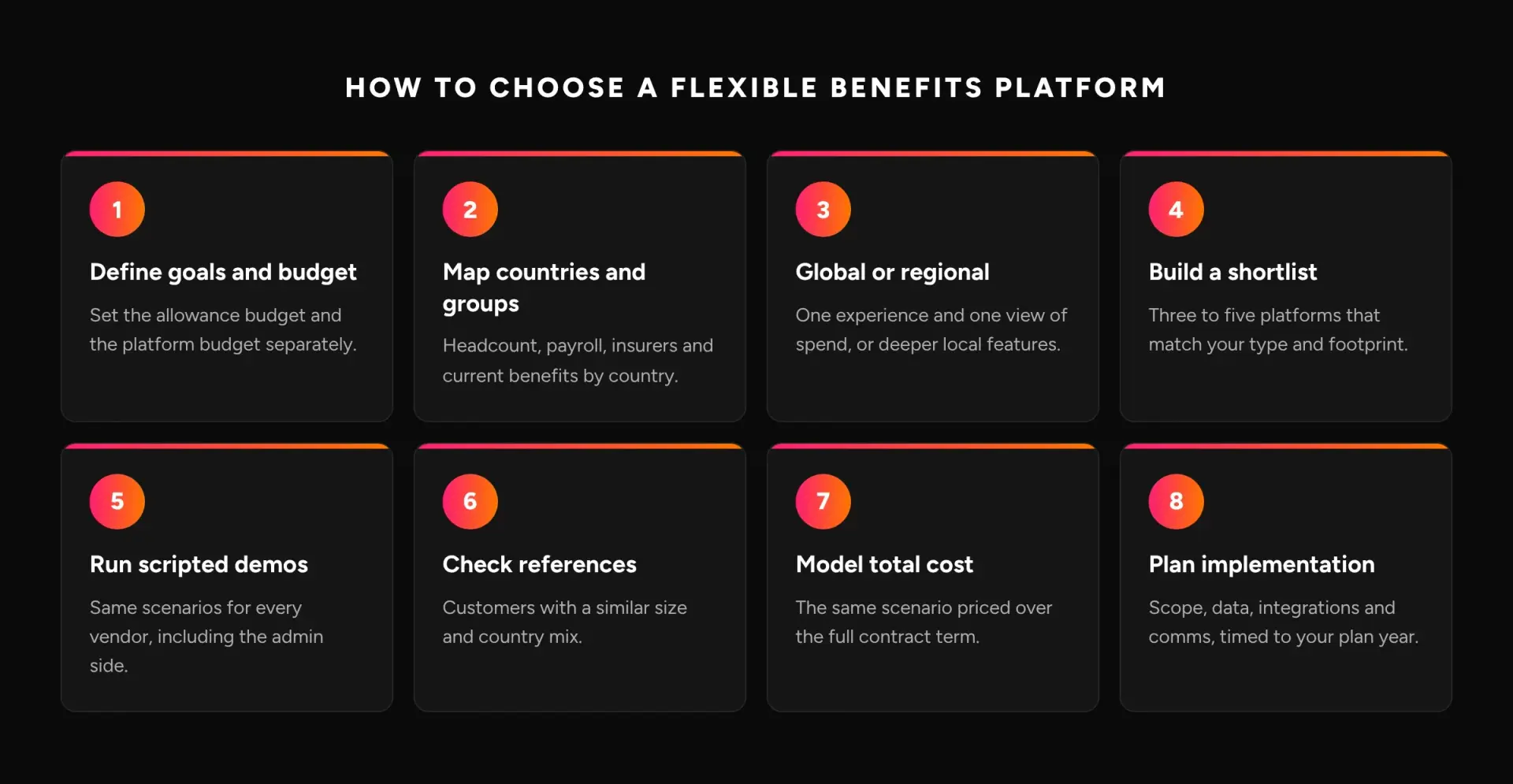
- Define your goals and budget. Agree what the programme should achieve, such as more choice, better take-up, a clearer view of spend or fewer systems. Set the allowance budget and the platform budget separately, so one does not hide the other.
- Map your countries and employee groups. List every country with its headcount, payroll provider, insurers and current benefits. Note groups with different rules, such as executives, hourly staff or contractors.
- Decide between one global platform and regional platforms.
Some employers use a mix, so decide where the line sits for you. - One platform gives a single employee experience and one view of spend, but local depth varies by country.
- Regional platforms may go deeper in one market, but add systems, contracts and reporting work.
- Build a shortlist. Pick three to five platforms that match your type and footprint. Use the criteria in this guide to rule platforms out early.
- Run scripted demos. Give every vendor the same scenarios, for example a new hire in two countries, a mid-year life event and a claim against an allowance. Ask to see the admin side, not just the employee app.
- Check references. Ask for customers with a similar size and country mix. Ask them about implementation, support and payroll accuracy.
- Model total cost. Price the same scenario with each vendor over the full contract term, including implementation, modules, transaction fees and your own internal time.
- Plan implementation. Agree scope, timeline, data migration, integrations and employee communication before you sign. Plan the launch around your plan year and enrolment window.

Common buying mistakes to avoid
- Choosing on the employee app alone. A polished app matters, but admin rules, payroll and reporting decide whether the programme runs smoothly.
- Assuming country coverage means local benefits. A platform that can pay an allowance in a country may not support local insured benefits there.
- Comparing quotes that cover different things. Ask every vendor to price the same scope and term.
- Leaving payroll and tax until late. Bring payroll and tax advisers in during the shortlist, not after the contract is signed.
- Skipping data and security checks. Benefits data is sensitive, so review certifications and data storage before you commit.
- Underestimating communication. Employees need to understand their choices, or the flexibility you pay for goes unused.
Questions to ask vendors
Use these questions in demos and in your request for proposal. Ask every vendor the same ones, and ask for written answers where it matters.
Plan design and eligibility
- Which plan designs can we configure ourselves, and which need your team?
- How do eligibility rules handle location, grade, contract type and length of service?
- How do you handle life events and mid-year changes?
Countries, currency and tax
- In which of our countries do you support local benefits, not just payments?
- How do you handle multiple currencies and currency conversion?
- How does the platform support local tax treatment, and what stays with our advisers?
Payroll and integrations
- Which of our HR, payroll and insurer systems do you integrate with today?
- How are payroll files and reconciliation handled each cycle?
- Who builds and maintains custom integrations, and at what cost?
Security and data
- Which certifications do you hold, and can we see the reports?
- Where is employee data stored, and who can access it?
Pricing and contract
- What exactly does the per-employee or platform fee include?
- Which fees, if any, are charged to employees?
- How is price set at renewal, and how do we export our data if we leave?
Implementation and support
- What does implementation look like for a company of our size and country mix?
- What support do employees and admins get, in which languages and at what hours?
- Can we speak to a customer with a similar footprint?
Frequently asked questions
What is a flexible benefits platform?
A flexible benefits platform is software that lets employees choose or allocate benefits from a set budget or menu, while HR manages the rules behind those choices. It typically handles eligibility, allowances, claims, reimbursement and reporting. Some platforms also cover insurance, pensions or recognition.
The aim is to give employees benefits that fit their lives, while giving HR and finance control of budgets and a clear view of spend.
What is the difference between flexible benefits and a benefits allowance?
A benefits allowance is one part of flexible benefits:
- An allowance is a set amount of money an employee can spend on approved categories, often through claims or a card.
- Flexible benefits is the wider approach. Employees choose from a menu that can include insured benefits, pensions, salary sacrifice options and allowances.
Some platforms focus on allowances, while others run the full menu.
How much does a flexible benefits platform cost?
It depends on the vendor, your headcount, your countries and the modules you need. Most vendors in this guide do not publish prices. Costs are usually built from:
- per-employee fees
- implementation or platform fees
- transaction or card fees
- add-on modules
Some providers charge employers nothing and earn from employee-side products. Ask each vendor to price the same scenario over the full contract term, so you can compare fairly.
Are flexible benefits taxable?
It depends on the country, the benefit and how the programme is set up. Some benefits may be taxed as income. Some may be paid for from pay before tax. Others may create employer taxes.
Rules vary by country and can change, so check local requirements with your tax and payroll advisers before you design the programme. A good platform supports local treatment, but it does not replace advice.
Should you use one global platform or regional platforms?
It depends on your footprint and goals:
- One global platform gives employees a consistent experience, gives HR and finance a single view of spend, and means fewer contracts to manage.
- Regional platforms can offer deeper local features in one market, such as salary packaging.
Some employers combine the two. Map your countries, headcount and must-have local benefits first, then test both options against your criteria.
How long does it take to implement a flexible benefits platform?
It depends on:
- the number of countries
- the benefits in scope
- the integrations you need
- how clean your data is
A single-country allowance programme is usually simpler than a multi-country programme with insurance and payroll integrations. Ask each vendor for a written plan for your scope, with milestones. Work back from your plan year and enrolment window so the launch is not rushed.
What integrations does a flexible benefits platform need?
Most programmes need a link to:
- your HR system, for employee data
- payroll, for deductions, allowances and reimbursements
Depending on your benefits, you may also need links to insurers, pension providers, brokers and benefit providers. Ask which integrations are ready-made, which are custom, and who maintains them. Clean, automatic data flows reduce manual work and the risk of payroll errors.
How do you measure the ROI of a flexible benefits programme?
Start with the goals you set for the programme, then track measures linked to them. Common measures include:
- take-up by benefit and employee group
- spend against budget
- employee feedback on benefits
- admin time saved
Some employers also look for links with retention or hiring, though these are harder to attribute. Agree the measures and a baseline before launch so you can compare results over time.
How many vendors should be on a shortlist?
Three to five vendors is a practical shortlist for most buyers. Fewer than three gives you little to compare. More than five makes scripted demos, reference checks and cost modelling hard to run well.
Use your must-have criteria, such as country coverage and payroll fit, to rule platforms out early. Then spend your time on a deeper review of the strongest options.
Why does Tallect appear in this guide?
Tallect publishes this guide, and its Benefits & Insurance module is one of the 11 platforms reviewed. We disclose this at the start of the guide, and the section on where Tallect differs is labelled as the publisher's view. Tallect's entry uses the same five-part format as every other platform, including a section on where it may not be the best fit.
Run benefits in every country from one place
Tallect brings flexible benefits, insurance and employee policies across your countries into one platform, with the full benefit spend shown in your total rewards view.