What Is a Lifestyle Spending Account (LSA)? Employer Guide for 2027
What a lifestyle spending account is, how it works, what it can cover, and how to set one up for a global workforce.
A lifestyle spending account is an employer-funded budget that employees can spend on approved categories they choose, such as wellbeing, learning or family support. Employees usually spend it in one of two ways:
- with a benefits card
- by paying first and claiming the money back
The employer sets the amount and the rules. Each employee decides what is most useful to them.
This guide covers:
- what a lifestyle spending account is
- how one works day to day
- how it differs from other benefit accounts and stipends
- what it can cover
- its advantages and risks
- what changes when you run one across several countries
- a step-by-step plan for setting one up
What a lifestyle spending account is
A lifestyle spending account is a pot of money that an employer gives each eligible employee to spend on a defined set of categories. The employer funds it in full, and employees do not contribute from their own pay. Within the approved categories, each employee chooses what to spend it on and when.
The term "lifestyle spending account" is used mostly in North America. Employers elsewhere often run the same idea under other names, such as:
- a flexible allowance
- a wellbeing allowance
- a benefits wallet
The design is broadly the same: a set budget, a list of eligible categories and a way to spend or claim. In this guide, we use "LSA" for all of them.
An LSA is different from salary or a one-off bonus in three ways:
- It has a purpose. Salary and bonuses can be spent on anything. An LSA can only be spent on the categories the employer approves, so it supports specific goals, such as wellbeing, learning or family life.
- It is recurring and visible as a benefit. Employees see it as part of their benefits package, with its own balance and its own rules, rather than as part of their pay.
- It is managed as a programme. The employer decides the budget, the categories, how unused funds are handled, and how spending is checked and reported.
Employers use LSAs for several reasons:
- Employees have different needs. One person wants a gym membership, another wants help with childcare, and another wants a course or a better desk chair. A single budget with a list of categories lets each person choose, instead of the employer guessing.
- They suit distributed and hybrid teams. An LSA does not depend on an office, a local supplier or a single vendor.
- They replace scattered perks. Many employers like replacing a set of separate perks, each with its own budget and supplier, with one budget that is easier to plan and explain.
How an LSA works
Every LSA is built from the same building blocks. The choices you make for each one decide:
- how the account feels to employees
- how much it costs
- how much work it creates
Funding amount and cadence
The employer sets an amount per eligible employee and decides how often to fund it: monthly, quarterly or annually.
- Annual funding gives employees the full amount at once, which suits larger purchases.
- Monthly or quarterly funding spreads the cost and the spending through the year. It also limits the amount at risk if someone leaves early.
Some employers set different amounts by grade, country or working pattern. Others give everyone the same amount.
Eligible categories
The employer defines what the money can be spent on. Categories might include:
- fitness
- mental wellbeing
- learning
- family support
- home office equipment
Clear categories, with examples of what is and is not included, make life easier for employees and for whoever approves claims.
How employees spend, and proof of purchase
There are two common ways to spend an LSA:
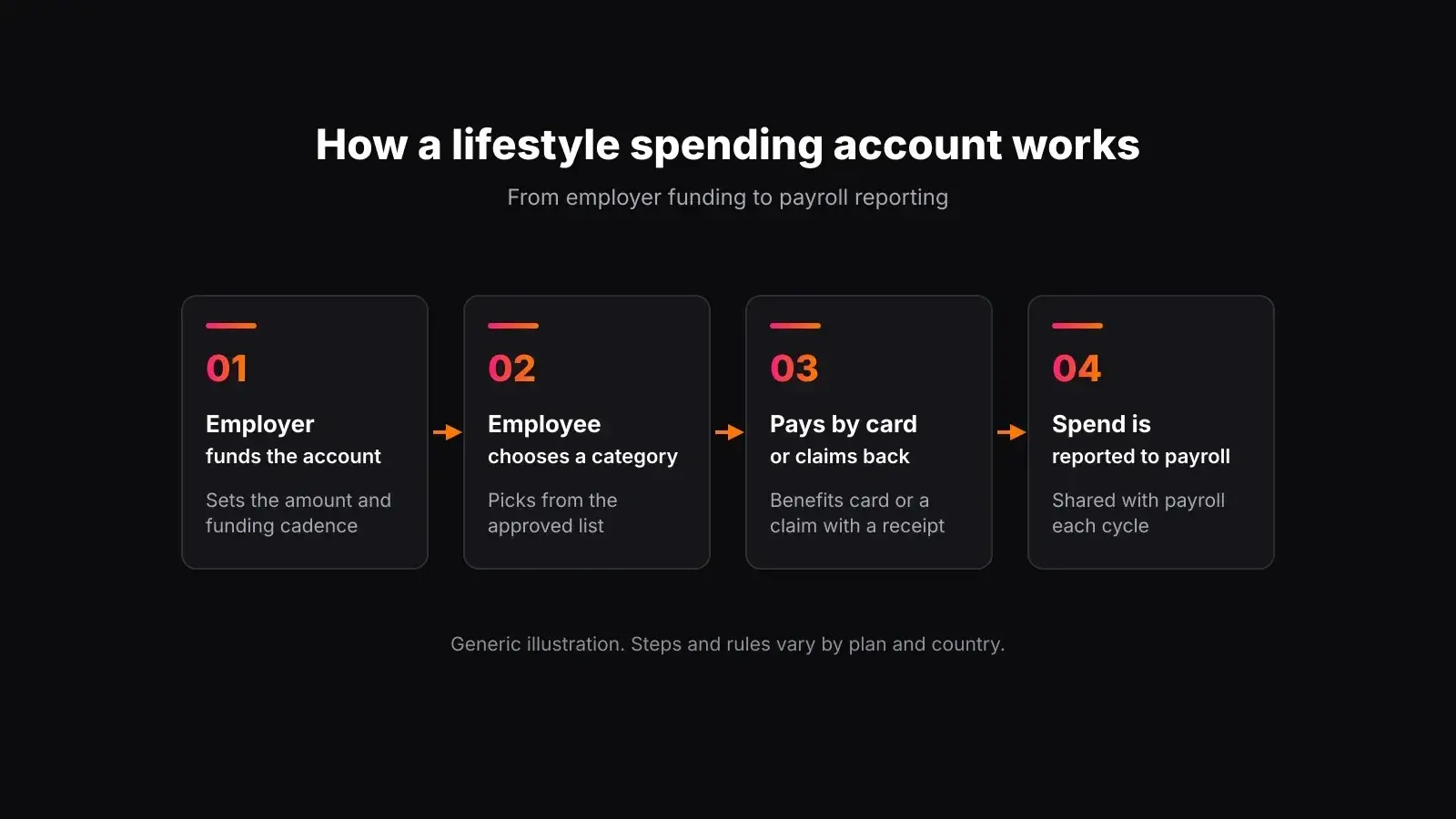
- A benefits card. The employer or provider issues a card loaded with the balance. Some cards can be set to work only at certain types of merchant, which means fewer purchases to check one by one.
- Reimbursement. The employee pays first, then submits a claim with a receipt. Someone checks the claim against the categories and approves it for payment.
Most programmes ask for proof of purchase, such as a receipt or invoice, at least for reimbursements. Decide up front:
- what proof is needed
- how long employees have to submit it
- who reviews it
What happens to unused funds
What happens to unused funds is a design choice:
- Expiry. In some programmes, the balance expires at the end of each period or the end of the year. This keeps costs predictable, but it can feel like a loss to employees.
- Roll-over. In others, the balance rolls over, sometimes up to a cap. This feels more generous, but it can build up large balances that the employer must track.
Tax and accounting treatment of each option depends on the country and the plan design, so check with your advisers.
Joiners, leavers and part-time staff
Decide how the amount works for each group:
- Joiners partway through a period. Common approaches are pro-rating the amount by months of service, or funding only from the next full period.
- Leavers. Decide whether unused funds simply lapse, and whether they can still claim for purchases made before their leaving date.
- Part-time staff. Decide whether they receive the full amount or a pro-rated one.
How spend is reported to payroll
LSA spending often needs to be reported to payroll, so that each employee's pay records are complete. Whether and how it is reported, and how it is taxed, depends on the country and the plan design.
Agree the process with your payroll team and advisers before launch, including what data payroll needs and how often.
A worked example
Here is how an LSA might work for one company and one employee. All figures are illustrative. They are not a recommendation, a benchmark or a typical plan.
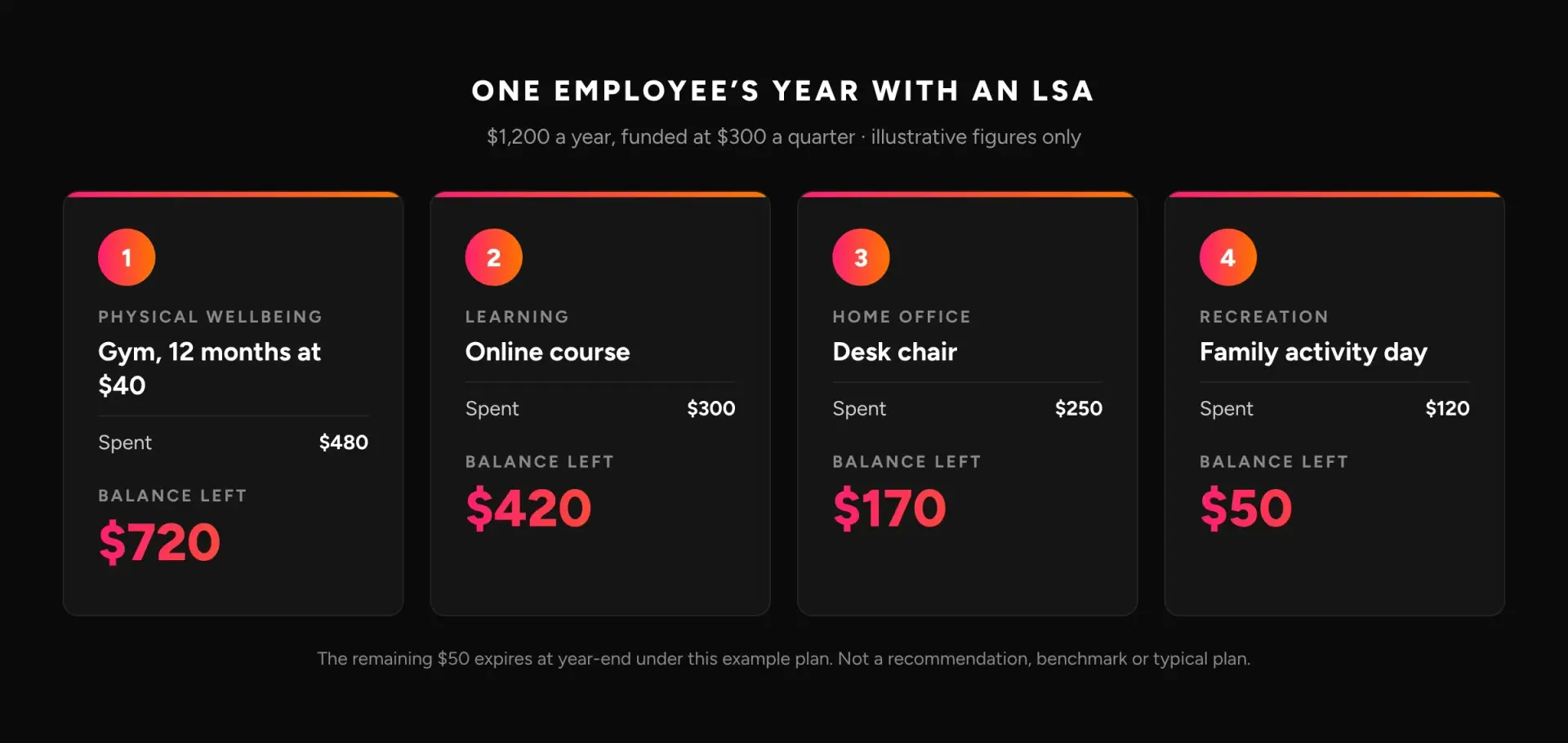
A hypothetical company offers an LSA of $1,200 a year to each eligible employee, funded at $300 a quarter. It has 500 eligible employees. The maximum annual programme budget is 500 × $1,200 = $600,000.
The actual cost depends on how much employees use. If some employees leave part of their balance unspent and unused funds expire, the company spends less than the maximum.
One hypothetical employee uses their year's allowance like this:
Category | What was bought | Illustrative amount | Remaining balance |
|---|---|---|---|
Physical wellbeing | Gym membership, 12 months at $40 | $480 | $720 |
Learning and development | Online course | $300 | $420 |
Remote and hybrid work setup | Home office chair | $250 | $170 |
Lifestyle and recreation | Family activity day | $120 | $50 |
Caption: Illustrative figures only, based on a $1,200 annual LSA funded at $300 a quarter. They are not a recommendation, a benchmark or a typical plan.
Funds arrive at $300 a quarter, so the employee times larger purchases, such as the course and the chair, after each top-up. Under this example plan's rules:
- unused funds carry over from one quarter to the next
- the remaining $50 expires at the end of the year
LSA vs other accounts and stipends
An LSA is one of several ways to give employees money for specific purposes. The names can be confusing, especially because some of them are specific US accounts. Here is how they differ in purpose, funding and flexibility.
- Flexible spending account (FSA). A specific US account that employees fund mainly through their pay, sometimes with an employer contribution. It is used for certain eligible costs, such as some health or dependent care expenses. It covers a narrower set of costs than an LSA and is shaped by US rules.
- Health savings account (HSA). A specific US account linked to certain types of health plan. The employee owns it, and the employee, the employer or both can fund it. It is used for eligible health costs. It is designed for health spending and long-term saving, not lifestyle choices.
- Health reimbursement arrangement (HRA). A specific US arrangement that the employer funds to reimburse employees for eligible health costs. Like an LSA, it is employer-funded, but it covers health costs only.
- Single-purpose stipends. Many employers offer a stipend for one purpose, such as learning, home office equipment, or phone and internet costs. A stipend is simple to explain and directly supports one goal, but employees cannot redirect it to what they need most. Our guide to learning stipends covers when a dedicated budget makes sense.
- A wider flexible benefits plan. This lets employees choose from a broader menu that can include insured benefits, pensions and other options, usually on top of core benefits. An LSA can be one part of such a plan, offering a cash-style budget alongside the other choices.
Tax treatment of each of these options depends on the country and the plan design, so check local rules and take advice.
Option | Who funds it | What it can cover | How flexible it is | Main difference from an LSA |
|---|---|---|---|---|
Lifestyle spending account (LSA) | Employer | A broad set of approved categories | High, within the categories | Not applicable |
Flexible spending account (FSA, US) | Mainly the employee | Certain eligible health or dependent care costs | Low to medium | Employee-funded and narrower |
Health savings account (HSA, US) | Employee, employer or both | Eligible health costs | Medium, for health only | Linked to certain health plans and owned by the employee |
Health reimbursement arrangement (HRA, US) | Employer | Eligible health costs | Low to medium | Health costs only |
Single-purpose stipend | Employer | One defined purpose | Low | Cannot be redirected to other needs |
Flexible benefits plan | Employer, sometimes with employee contributions | A menu of benefits, including insured options | High, across a wider menu | Broader; an LSA can sit inside one |
Caption: How an LSA compares with other benefit accounts and stipends.
What an LSA can cover
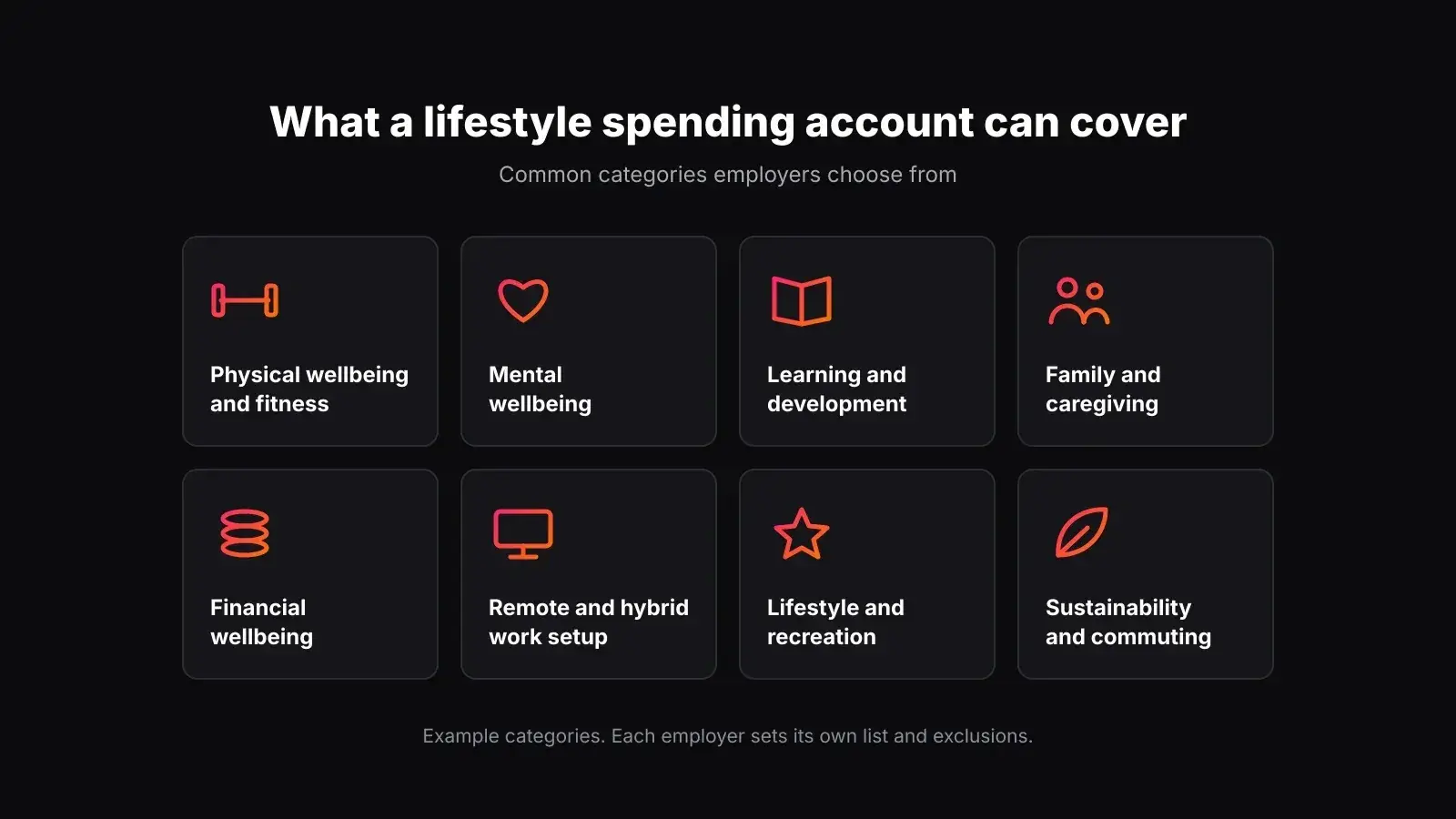
An LSA can cover almost anything the employer chooses to include. The categories below are common, and most programmes pick several of them.
Physical wellbeing and fitness
- Gym or fitness studio memberships
- Fitness classes or personal training
- Sports equipment and clothing
- Race or event entry fees
- Fitness trackers
Mental wellbeing
- Meditation and mindfulness apps
- Coaching sessions
- Wellness retreats
- Hobby and relaxation classes
Learning and development
- Online courses and certifications
- Language lessons
- Books and learning subscriptions
- Workshops and conferences
Family and caregiving
- Childcare or after-school activities
- Support for caring for an older relative
- Pet care
- Family activities and outings
Financial wellbeing
- Financial planning or advice sessions
- Budgeting tools and apps
- Financial education courses
For more on this area, see our guide to financial wellness benefits.
Remote and hybrid work setup
- Desk chairs and standing desks
- Monitors, keyboards and other equipment
- Internet or phone costs
- Co-working space passes
Lifestyle and recreation
- Hobbies and creative classes
- Travel or experience days
- Cultural events and museum passes
- Outdoor activities
Sustainability and commuting
- Bikes and bike repairs
- Public transport passes
- Sustainable household products
- Electric vehicle charging
What employers commonly exclude
Most programmes also list items that cannot be bought with LSA funds. Common exclusions include:
- cash withdrawals, and gift cards that can be used like cash
- alcohol and tobacco
- gambling
- items already covered by another benefit
- purchases for anyone outside the eligible family
A clear exclusions list cuts down on rejected claims and awkward conversations.
Category | Examples | Commonly excluded items |
|---|---|---|
Physical wellbeing and fitness | Gym, classes, equipment | Items covered by health insurance |
Mental wellbeing | Apps, coaching, retreats | Treatment covered by other benefits |
Learning and development | Courses, languages, books | Courses already paid by the company |
Family and caregiving | Childcare, elder care, pet care | Costs for people outside the eligible family |
Financial wellbeing | Advice, budgeting tools | Loan or debt repayments |
Remote and hybrid work setup | Chairs, monitors, internet | Equipment the company already provides |
Lifestyle and recreation | Hobbies, experiences, events | Alcohol, tobacco, gambling |
Sustainability and commuting | Bikes, transit passes, charging | Fuel for personal vehicles, if excluded by policy |
Caption: Common LSA categories, examples and items employers often exclude.
Advantages for both sides
A well-designed LSA can work for both employees and employers.
For employees
- Choice and inclusion. Employees spend the budget on what fits their life, whether that is fitness, family, learning or a better home office. People with different needs get equal value from the same programme.
- Perceived value. Money that employees choose how to spend tends to feel more valuable than a perk they did not ask for.
- Simplicity. One balance and one set of rules is easier to understand than several separate perks.
For employers
- Simpler budgeting. The employer sets a clear amount per employee and a clear maximum programme cost, which makes planning easier.
- Fewer separate vendors. One LSA can replace several single-purpose perks, each with its own supplier, contract and budget.
- Recruitment and retention. A flexible budget is easy to explain to candidates, and gives current employees a visible, valued benefit.
- Insight into what employees value. Spending data shows which categories people use, which helps the employer refine the programme.
- Consistency across locations. One LSA can give office-based, hybrid and remote employees the same benefit, without depending on on-site facilities or local suppliers.
The advantages are strongest when the LSA has a clear purpose. Take a programme that says "this budget is for your wellbeing and growth" and lists categories that match. It is easier to explain, easier to defend in budget discussions and more likely to be used well than a loosely defined allowance.
Drawbacks and risks
LSAs also bring challenges. Each one can be managed with good design.
- Tax and payroll handling. LSA spending may need to be reported through payroll, and treatment varies by country and plan design. Reduce the risk by agreeing the approach with tax and payroll advisers before launch, and building reporting into the process from day one.
- Unused funds and low take-up. Some employees forget about their balance, or are unsure what they can buy. Regular reminders, clear examples and a simple way to check the balance all help.
- Admin and claims volume. Reimbursement claims take time to check and approve. A benefits card, clear categories and simple proof-of-purchase rules reduce the number of manual checks.
- Employees treating it as cash. If categories are too broad, an LSA can feel like extra salary, and its purpose is lost. Focused categories and a clear exclusions list keep the link to the programme's goals.
- Fairness across roles and countries. Equal amounts can mean very different value in different countries or for part-time staff. Decide deliberately whether to use equal or equitable amounts, and explain the reasoning.
- Keeping categories relevant. Needs change over time. Reviewing categories each year, using spending data and employee feedback, keeps the programme useful.
Most of these risks are easier to handle before launch than after it. Decide the rules on tax, unused funds, proof of purchase and fairness up front, and write them into the policy. That avoids changing the programme once employees are used to it.
Changes that take something away, such as narrowing categories or ending roll-over, are much harder to explain than rules that were clear from the start.
Running an LSA across countries
An LSA can work well across countries, but a few design choices matter more when your employees are spread around the world. Rules vary by country, so check local requirements and take advice in each market.
- Currencies and cost of living. Decide whether to set amounts in one currency or in local currencies. Local-currency amounts are easier for employees to understand, and protect them from exchange-rate swings. The same amount also buys very different things in different places.
- Equal versus equitable amounts. Some employers give everyone the same amount, so the programme feels simple and fair. Others adjust amounts by country to reflect local costs, so the benefit has similar real value everywhere. Either can work. The key is to choose deliberately and explain why.
- Local categories and exclusions. Some categories make sense everywhere, while others depend on local practice. Commuting support, childcare options and common wellbeing services differ between markets. A global list with local additions and exclusions keeps the programme relevant.
- Local tax and payroll reporting. Each country may treat LSA spending differently and need different payroll reporting. Work with local advisers and payroll providers to confirm the treatment and the data they need.
- Card acceptance or reimbursement by market. A benefits card may work well in some countries and less well in others. Where cards are not practical, reimbursement is the usual fallback. Check how employees in each market will actually spend.
- Communication in each market. Employees in different countries may read the same policy differently, especially if it uses terms common in one market but not another. Three things help:
- Use plain language and give local examples of eligible purchases.
- Translate key guidance where needed.
- Add a short local FAQ, which often answers questions that would otherwise reach HR one by one.
- One global policy with local rules. The most manageable approach is one global LSA policy that sets the purpose, principles and core categories. Each country then gets a short local appendix covering amounts, currency, extra categories, exclusions and payroll handling.

How to set up an LSA
Setting up an LSA is mostly a policy and design exercise. These steps give a practical order of work.
- Set goals. Agree what the LSA should achieve, such as supporting wellbeing, replacing scattered perks or improving perceived value.
- Set the budget. Decide the amount per employee, the maximum programme cost, and how the amount may vary by country or group.
- Decide eligibility. Agree who qualifies, including part-time staff, new joiners and employees on leave.
- Choose categories and exclusions. Pick categories that fit your goals and your workforce, and write a clear exclusions list.
- Set the funding cadence and unused-funds rule. Choose monthly, quarterly or annual funding, and decide whether unused funds expire or roll over.
- Agree tax and payroll handling with advisers. Confirm the treatment and reporting in each country before launch.
- Choose how it will be run. Smaller programmes sometimes start with reimbursement through expenses. Larger or multi-country programmes usually need a system to manage balances, spending, approvals and reporting. Our guide to flexible benefits platforms explains the options. As one example, Tallect's Benefits & Insurance module offers:
- a spending account or wallet, with flexibility and employee self-managed choices
- centralised budget and spend management
- a globally consistent benefits framework that stays regionally compliant
- Write the policy. Set out the purpose, amounts, categories, exclusions, proof-of-purchase rules, unused-funds rule, and what happens for joiners and leavers.
- Communicate and launch. Explain the LSA in plain words, with examples of what people can buy and how to spend or claim.
- Review take-up and categories each year. Look at what employees bought, which categories went unused and what people asked for, then adjust.
Decision | Common options | What to consider |
|---|---|---|
Amount | Same for all, or varied by country or group | Fairness, cost of living and budget |
Funding cadence | Monthly, quarterly or annual | Cash flow, larger purchases and leaver risk |
Unused funds | Expire each period, expire yearly, or roll over | Cost predictability versus employee perception |
Categories | Broad list or focused list | Programme goals and the risk of it feeling like cash |
Spending method | Benefits card, reimbursement or both | Admin effort and how well cards work in each market |
Proof of purchase | Receipts for all, or for claims only | Control versus ease for employees |
Joiners and leavers | Pro-rated or from the next full period | Fairness and admin simplicity |
Payroll reporting | Per pay cycle or per period | Local requirements and payroll capacity |
Caption: The main design decisions for an LSA, the common options and what to weigh.
Frequently asked questions
What is a lifestyle spending account in simple terms?
A lifestyle spending account is money an employer gives employees to spend on things that support their wellbeing and lifestyle, within categories the employer approves. Employees might use it for a gym, a course, a home office chair or family activities.
They usually spend it with a benefits card, or pay first and claim it back. The employer sets the amount, the categories and the rules.
Are lifestyle spending accounts taxable?
It depends on the country and the plan design:
- the same LSA can be treated differently from one country to the next
- the treatment can depend on what employees buy and how the programme is set up
- rules can change over time
Before you launch an LSA, or add a new country or category, check local requirements with your tax and payroll advisers. Agree how spending will be reported.
What is the difference between an LSA and an FSA?
- An FSA is a specific US account that employees fund mainly through their pay, sometimes with an employer contribution. It is used for certain eligible costs, such as some health or dependent care expenses.
- An LSA is funded by the employer and can cover a much broader set of lifestyle categories, such as fitness, learning or home office equipment. It is also not limited to one country.
What is the difference between an LSA and an HSA?
- An HSA is a specific US account linked to certain types of health plan. It belongs to the employee, can be funded by the employee, the employer or both, and is used for eligible health costs and long-term saving.
- An LSA is an employer-funded budget for a broader set of lifestyle categories. It is not tied to a health plan, and the employer sets its rules.
Do LSA funds roll over?
It depends on how the employer designs the programme:
- some LSAs let unused funds roll over to the next period or year, sometimes up to a cap
- others let unused funds expire at the end of each period or at year-end
Each approach has different cost and accounting effects, which can vary by country. Whatever you choose, state the rule clearly in the policy and remind employees before funds expire.
How much should an employer put in an LSA?
There is no single right amount. Start from your goals and your total benefits budget. Then decide what amount per employee would make a real difference in the categories you want to support. Also consider:
- the cost of living in each country
- whether you are replacing existing perks
- how the amount compares with your other benefits
Model the maximum programme cost before you decide, and review the amount each year.
Can you offer an LSA to employees in other countries?
Yes. Many employers run one LSA across several countries. It works best with one global policy that sets the purpose and core categories, plus local rules for amounts, currency, extra categories, exclusions and payroll handling.
Check how a benefits card works in each market, and plan for reimbursement where cards are not practical. Confirm the tax and payroll treatment with local advisers.
What happens to LSA funds when an employee leaves?
It depends on the employer's policy. Commonly:
- unused funds lapse when the employee leaves
- the employee may have a short period to claim for purchases made before their leaving date
- some employers pro-rate the amount for the final period
Set the rule out clearly in the LSA policy. Check with HR and legal advisers how it fits with employment contracts and local requirements.
Run one flexible wallet in every country
Tallect gives employees a flexible spending wallet within one global benefits framework, with centralised budget and spend control for your team.